How Much Do You Averagte Making Selling Beef Cattle 2017

- Selling Versus Marketing
- Know Your Cost
- Plan for the Market
- Feeder Calf Marketing Alternatives
- Which Cattle to Produce
- Where to Market
- Choose the Right Marketing Method
- When to Market place
- Keeping Up with the Market
- References
Nearly cattle produced in Georgia come from cow-calf farms and ranches. With cow-calf operations, every bit with other farm enterprises, making a profit is the only affair that volition keep you in business. How much profit you make depends largely on your power to market your calves.
Selling Versus Marketing
Profitable cattle marketing involves more than just getting the highest price. It involves producing the blazon of dogie the market desires, marketing that dogie through the all-time outlet and at the best time. Unfortunately, nearly moo-cow-calf producers simply sell their calves. They produce calves that are the easiest to raise, sell at the near user-friendly market outlet and sell at the most user-friendly fourth dimension. As a result, they are toll-takers.
Marketing means making choices near how or what product to produce, where to market information technology and when to price. As a result, marketers have some control over the price they receive.
The commencement footstep in becoming an effective cattle marketer is to recognize all your alternatives and evaluate each in low-cal of potential cost and returns, selecting the most profitable rather than the virtually convenient alternative.
This publication addresses several issues associated with marketing calves -- most notably, cost considerations, market structure, the type of calf to produce, market outlets and seasonal price considerations.
Know Your Cost
The outset stride in any successful marketing program is to know the unit price of product (UCOP). In fact, for many small-scale or medium-size cow herds, the price of production is a larger profit determinant than the marketing method. Regardless of the size of the herd, for cow-calf producers this means knowing the toll per pound of calf sold. The best way to make this determination is to begin with a upkeep like to the 1 shown in Table 1.
| Table ane. Instance summary budget for a cow-calf enterprise in Georgia. | ||
| ITEM | $/Cwt. | $/Cow |
| Variable Cost | $137.14 | $609.06 |
| Less: Value of cull cows, bulls and heifers | ($26.88) | $119.40 |
| Cyberspace VARIABLE Cost | $110.25 | $489.66 |
| Annual Livestock Fixed Costs | $xi.43 | $50.76 |
| Annual Buildings & Facilities Stock-still Costs | $7.16 | $31.82 |
| Annual Equipment Fixed Costs | $21.02 | $93.37 |
| Annual Land Stock-still Costs Excluding Taxes | $0.00 | $0.00 |
| Almanac Real Manor Taxes | $ane.37 | $half-dozen.11 |
| TOTAL COSTS | $149.87 | $665.61 |
| Source: 2012 UGA beefiness cow-calf budgets | ||
Annotation that while the cost per cow is shown, the accent is placed on $/Cwt. The toll per hundredweight sold is used because it captures not only total herd costs but also dogie ingather percentage and weaning weights.
In the example budgets shown, there are ii numbers highlighted -- the first one existence variable cost in $/Cwt. Variable costs (VC) are too called Direct, "Out of Pocket" or Operating Costs and include items such as feed, seed fertilizer, fuel and labor. These are the costs that must exist covered each twelvemonth because they are the measure out of profitability. Information technology is too disquisitional to embrace variable costs considering whatever returns above variable costs (ROVC) go toward paying overhead or stock-still costs.
Returns above total costs (ROTC) is the measure of the long-term economic sustainability of an enterprise. Total costs (TC) include not merely VC merely also stock-still costs (FC) such as depreciation, cost of capital letter, direction, taxes, etc. FC are those costs that occur regardless of the number of head produced. Some people likewise refer to FC equally overhead or indirect costs. Regardless of the terms used, the total toll (TC) per hundredweight is the toll a cow-calf producer must average in the long run if they want to remain in business.
Knowing the VC and TC per hundredweight allows producers to fix target prices and evaluate their costs in relation to the market. While weather and input costs can be volatile in the curt term, which will bear upon cost per hundredweight twelvemonth-to-year, producers who consistently have break-even prices above market prices will need to find ways to lower their costs in lodge to stay in the business.
Programme for the Market
The old saying goes that if you don't know where you're going, any road will take you there. Merely if marketing your cattle at a turn a profit is where you want to become, so planning for the market will assistance get you there. Planning requires information. A expert style to get-go becoming a better cattle marketer is being sure y'all understand the cattle marketing organization and how your cattle prices are determined. And then you need to recognize all the market place alternatives available to you. Finally, you need to know where to get the information to help y'all decide on a marketing plan.
The Georgia Feeder Cattle Marketplace
 Effigy 1. Seasonal prices of feeder steers and bulls in Georgia auction markets. 2007-2011. Data source: USDA-AMS, Weekly Auction Report, TV_LS145 (various weeks).
In Georgia, as in the Southeast, feeder calves are produced and sold as feeder calves after weaning. Nearly lxx percentage of all Southeastern calves are weaned and sold during the fall. This is the major reason backside the normal seasonal price swings shown in Figure ane: prices are unremarkably lower during the autumn and higher during the late wintertime and early spring.
There are around 17,000 cattle producers in Georgia with an average herd size of fewer than 50 caput. With so many small producers, it is natural that virtually Georgia feeder calves are sold through local sale markets.
Calves weighing betwixt 300 and 500 pounds will normally motion into some type of forage-based stockering programs, where another 300 to 400 pounds will be added. Every bit heavyweight feeders, between 600 and 800 pounds, they then will typically motility direct into feedlots.
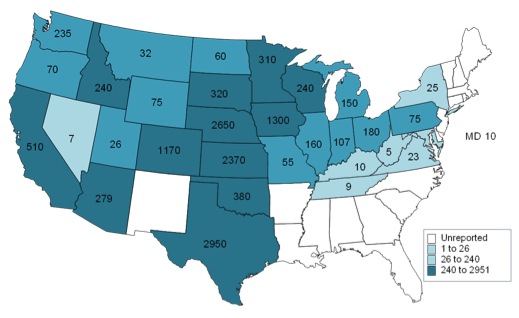 Effigy ii. Cattle on feed in yards with more than than 1,000 head (January ane, 2012). Source: Data provided by USDA-NASS, "Cattle" Report. Chart developed by the Livestock Marketing Information Centre (LMIC).
Unremarkably, 70 to 75 per centum of all U.South. beefiness comes from cattle fed in feedlots. Feedlots have go fewer but larger in size. The superlative three feedlot states (Texas, Nebraska and Kansas) now marketplace almost sixty per centum of the cattle fed in the United States. Effigy 2 illustrates the concentration of the cattle feeding industry in the United States every bit of January one, 2012.
While there are definite segments to the beef production arrangement, the important point to think is that the consumer eventually makes the final pricing determination. The retailer wants a sure type of production because the consumer wants it. This is relayed back to the packer, who relays it to the feedlot, who relays it to the feeder cattle producer. The "relay" for all these messages is the toll. Unfortunately, because of all the messengers in the market, the signals sometimes go mixed or muted. However, if we pay close enough attention, nosotros tin can recognize them. By understanding how the beef cattle markets work, feeder cattle producers will exist better able to recognize changes that may make a higher turn a profit.
Feeder cattle prices are derived from their next market. The calves' value is based on what they are expected to be sold for, either out of the feedlot or out of a backgrounding operation, less the toll of gain. As the expected price of finished animals goes up or the price of gain goes down, feeder calf prices volition increment. The weight to be added is factored in with the expected price of finished cattle. A i,200-pound finished steer weighs two.40 times as much as a 500-pound feeder calf and 1.lx times as much as a 750-pound yearling. Therefore, a $ane-per-hundredweight increase in the expected selling price of a finished steer would cause a buyer to bid $2.40 per hundredweight more for a 500-pound feeder calf or $1.sixty more than for a 750-pound steer.
The cost of finishing the dogie will also touch the price of the feeder. The cost of putting a pound of gain on a calf depends on feed cost, non-feed costs such equally involvement, and the efficiency of the calf itself.
A feeder buying a 500-pound dogie and finishing it to 1,200 pounds is putting on 700 pounds of gain, or 1.40 times the original weight. Finishers buying 750-pound yearlings and finishing to 1,200 pounds are putting on 0.64 times the original weight. Each $1 modify in the price of gain will raise or lower the price finishers tin pay by $1.40 for a 500-pound dogie and $0.64 for a 750-pound feeder. Table ii shows the intermission-fifty-fifty purchase prices that could exist paid for a 550-pound steer given alternative fed-cattle prices and price of gain. Of course, feeder calves produced in Georgia are likely to be transported to the feedlot states. Thus, a feedlot will as well have to discount the feeder price in Georgia by the cost of transporting the calves to the feedlot.
| Tabular array 2. Prices that tin be paid for a 550-pound feeder steer at alternative fed-cattle selling prices and toll of gain. | ||||
| Sales Cost of Finished Cattle ($/Cwt.) | ||||
| Cost of Gain ($/Cwt.) | $ 105.00 | $ 115.00 | $ 125.00 | $ 135.00 |
| $ lxx.00 | $ 149.55 | $ 172.27 | $ 195.00 | $ 217.73 |
| $ 80.00 | $ 136.82 | $ 159.55 | $ 182.27 | $ 205.00 |
| $ 90.00 | $ 124.09 | $ 146.82 | $ 169.55 | $ 192.27 |
| $ 100.00 | $ 111.36 | $ 134.09 | $ 156.82 | $ 179.55 |
| $ 110.00 | $ 98.64 | $ 121.36 | $ 144.09 | $ 166.82 |
| $ 120.00 | $ 85.91 | $ 108.64 | $ 131.36 | $ 154.09 |
CHANGES IN Beef AND LIVE CATTLE MARKETING
For years most alive cattle (too chosen slaughter or fat cattle) were marketed on a pen-boilerplate basis. That is, feed yards were paid 1 price for all of the cattle in the pen. However, over time that has changed. Now close to threescore% of all slaughter cattle are sold on a carcass ground where each carcass is individually weighed and graded for quality (marbling) and yield (percentage of retail meat). Since there are dissimilar prices for dissimilar yield and quality grades, each carcass ends upwards with an individual or customized price. The internet effect is that price transmissions from the packer dorsum to the cow-calf producer are much clearer now than in the by.
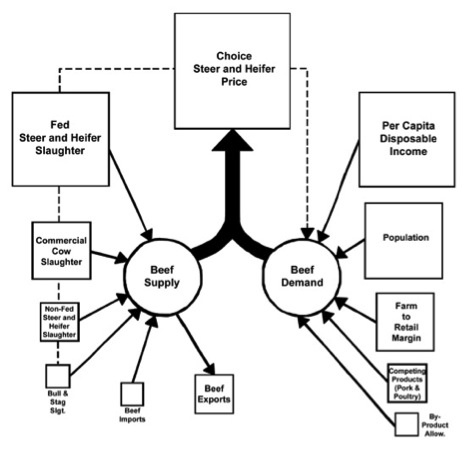 Figure 3. Factors that affect feeder cattle prices.
While it is the cost and render from finished cattle that give feeders their value, it is the overall supply and demand for beef that determines fed-cattle prices. Effigy iii illustrates the factors that affect fed-cattle prices. It is important to note that there are many things that impact the price of cattle and beef that moo-cow-calf producers cannot command. Notwithstanding, by being aware of these factors, cattlemen can accept some idea of expected prices and plan accordingly.
The variables are shown by different size squares depicting the relative importance of each. For example, fed steer and heifer slaughter contributes the about to beef supplies, followed by commercial moo-cow slaughter, non-fed steer and heifer slaughter, beefiness imports and exports, and bull and stag slaughter.
On the need side, per capita dispensable income, full population and competing meats (poultry and pork) are all important factors. Other factors, such equally the value of past-products and the cost of slaughter, processing and marketing (farm-to-retail margin), will too touch on subcontract prices.
Feeder Calf Marketing Alternatives
Webster?southward Dictionary defines "marketing" as the process or technique of promoting, selling and distributing a product or service. Information technology is important to keep in mind what your product is. Ultimately, a feeder dogie producer's product is beefiness. Georgia feeder calf producers take three major marketing decisions: what to produce, where to market their production and when to cost their calves. While some or maybe all of these decisions are ready for the producer, alternatives most likely exist. The choice of these alternatives will take a dramatic impact on the profitability of the cattle operation.
Which Cattle to Produce
The cow-calf producer influences the marketability of his cattle the day he selects his breeding stock. While information technology is true that most whatever type of cattle can be sold at a price, the Georgia cattle producer should be raising the about profitable cattle. There are many factors that determine the value of a feeder calf. Some of these factors can be influenced through an operation?south breeding and genetics program and others through good management practices. These factors include:
- Brood
- Color
- Frame
- Muscling
- Condition/Flesh
- Weight
- Sexual practice
- Groundwork
- Horns
- Fill up
- Personal Preference
- Vaccinations
Breed
The breed of the dogie tin can influence prices independent of grade. Certain breeds or breed-types bring a higher price because of perceptions by the guild heir-apparent equally to how these breeds volition perform in the feedlot. While these perceptions may or may not be correct, they exercise exist. One way to get around breed perceptions is to take reward of brood clan-sponsored marketing programs. Crossbred calves have traditionally been in higher demand than purebred calves because of the reward of hybrid vigor. However, in recent years, that trend has been challenged. Calves with a high pct of dairy or Brahman influence are typically discounted through the sale barn.
Color
Dogie color can also touch on the determination of value because it can be a clue into the calf'southward breeding. According to a study done in Arkansas in 2005, there was a $13.07/Cwt. spread betwixt selling prices of calves of various colors.
| Table 3. Price adjustments for various breeds. | ||
| Calf Color | Average Selling Toll (Value/Cwt.) | Deviation From Overall Average (Value/Cwt.) |
| xanthous-white face | $120.44 | $ii.34 |
| yellow | $120.29 | $2.19 |
| black-white face | $120.03 | $one.93 |
| blackness | $119.24 | $1.14 |
| gray | $117.66 | -$0.44 |
| grayness-white face up | $116.79 | -$1.31 |
| white | $116.01 | -$two.09 |
| ruby-white face | $114.58 | -$3.52 |
| red | $113.92 | -$iv.eighteen |
| spotted or striped | $107.37 | -$ten.73 |
| Source: Improving the Value of Feeder Cattle, FSA 3056. Arkansas Cooperative Extension. | ||
Frame
The United States Department of Agronomics has official grades for feeder cattle based on frame size, thickness and thriftiness (overall health). Frame size refers to the beast'south skeletal size ? its height and trunk length ? in relation to its historic period. Frame size is related to the weight at which, nether normal feeding and management, an animal volition produce a carcass of a given grade. Large-frame animals crave a longer time in the feedlot to reach a given class and will weigh more than a small-scale-frame animal would weigh at the same class. Animals are assigned to three frame sizes - Large, Medium and Pocket-sized. Table four describes the expected minimum live weights at which these calves would produce U.Southward. Option carcasses.
| Table four. Correlation betwixt frame size and finished slaughter weight. | ||
| Frame Size | Steers | Heifers |
| Big | 1250 | 1150 |
| Medium | 1100-1250 | grand-1150 |
| Small | < 1100 | < k |
| Source: USDA Agricultural Marketing Service, Livestock and Seed Program. U.s.a. Grades of Feeder Cattle. Effective appointment October 1, 2000. | ||
Muscling
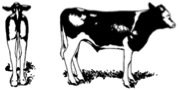
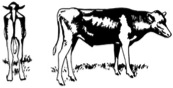
Muscling is evaluated past looking at the thickness of the animal. Thickness in feeder cattle refers to development of the muscle system in relation to skeletal size and is the amount of muscling present in proportion to bone and fatty. Thicker-muscled animals volition take more lean meat. The four thickness or muscling grades are No. ane, No. 2, No. 3 and No. 4.
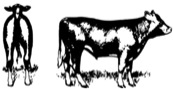 Muscling No. ane
No. i. Feeder cattle that possess minimum qualifications for this grade commonly display predominate beef breeding. They must be thrifty and moderately thick throughout. They are moderately thick and full in the forearm and gaskin, showing a rounded appearance through the back and loin with moderate width betwixt the legs, both front end and rear. Cattle show this thickness with a slightly thin covering of fat; however, cattle eligible for this grade may behave varying degrees of fatty.
 Muscling No. ii
No. 2. Feeder cattle that possess minimum qualifications for this form ordinarily show a high proportion for beef breeding and slight dairy breeding may be detected. They must be thrifty and tend to be slightly thick throughout. They tend to exist slightly thick and full in the forearm and gaskin, showing a rounded appearance through the back and loin with slight width between the legs, both front end and rear. Cattle show this thickness with a slightly thin covering of fatty; however, cattle eligible for this grade may behave varying degrees of fat.
 Muscling No. iii
No. 3. Feeder cattle that possess minimum qualifications for this course are thrifty and sparse through the forequarter and the centre function of the rounds. The forearm and gaskin are thin and the back and loin take a sunken appearance. The legs are set up close together, both front and rear. Cattle show this narrowness with a lightly thin covering of fatty; nevertheless, cattle eligible for this grade may carry varying degrees of fat.
No. 4. Feeder cattle included in this grade are thrifty animals that have less thickness than the minimum requirements specified for the No. 3 grade.
Junior. This form includes those feeder cattle that are non expected to perform normally in their present country and those that are "double-muscled." Cattle in this form may take whatsoever combination of thickness and frame size.
Thriftiness refers to the credible health of an animal and its ability to grow and fatten normally. In these standards, unthrifty animals are those that are non expected to perform ordinarily in their nowadays state due to such factors every bit disease, parasitism, severe emaciation or any condition that must be corrected earlier they could be expected to perform ordinarily. Unthrifty feeder cattle may have whatsoever combination of thickness and frame size.
Several market studies have been conducted in the mid-South and Plains regions since 2000. While the exact numbers for each of these studies varies, the clear message is that that smaller-frame, lighter muscled calves are discounted compared to medium-large frame, heavily muscled animals. An instance from a report conducted in Arkansas is shown below in Table 5.
| Table 5. Impacts of selected feeder cattle traits on sales price in Arkansas, 2010. | |
| Trait | Discount ($/Cwt.) |
| No. one Muscling | Base |
| No. 2 Muscling | -$8.94 |
| No. 3 Muscling | -$32.41 |
| No. four Muscling | -$57.18 |
| Large Frame | Base of operations |
| Medium Frame | 0.14 |
| Small Frame | -$22.10 |
| Source: Improving the Value of Feeder Cattle, FSA 3056. Arkansas Cooperative Extension. | |
Preconditioning
Preconditioning programs involve a series of management practices on the farm to ameliorate the wellness and nutrition of calves. Preconditioning adds value to calves for buyers. When preconditioned calves are marketed in a system that recognizes the value that has been added, moo-cow-calf producers benefit from the higher prices.
Preconditioning is not a new idea, but has received considerable attending in recent years with interest in value-added programs for cow-calf producers, beef quality assurance programs and strategic alliances in the beef manufacture. There are diverse preconditioning programs with different names and management requirements. Most programs crave a 45-day post-weaning phase with a sound nutritional program, specified animal wellness procedures, dehorning, castration of bull calves and bunk feeding. The purpose of preconditioning programs is to reduce stress from shipping calves at weaning, improve the immune system, and boost operation in postweaning production phases (i.e., stocker production and cattle feeding) and in carcass functioning (i.e., higher grading carcasses with fewer defects).
One common question is whether or non preconditioning programs add sufficient value to feeder calves to offset the added toll. Common preconditioning programs cost cow-calf owners about $60/head, depending on the cost of the ration, wellness of calves and length of the preconditioning programme. Equally a outcome, cattlemen will need to receive in excess of $60 (or their cost) per caput to brand pre-conditioning pay. It is important to remember that the boosted revenue tin come from reduced shrink and/or a higher toll. The main point is that those producers considering preconditioning should not focus just on receiving a college price.
No matter the type of cattle produced, dehorned, well-managed, clean, healthy-looking calves will always bring top-dollar prices. A Kansas Country University study of more than 140,000 head of feeder calves sold at auctions showed that cattle that were not in good wellness, had physical impairments or were muddy received big discounts. Dirty calves or calves with expressionless hair typically were discounted 2 pct, stale animals 7 to 9 pct and sick animals more than 25 percent. Castrated calves may non bring premiums at sale markets since buyers don't take fourth dimension to confirm each calf every bit he comes through the ring, only they volition bring premiums through other market methods that allow for seller identification. Specific health practices may also bring premium prices when the market place allows for the recognition of such practices.
The addition of these direction practices to a producer's functioning ways there is a need for adequate facilities to perform them. The power to safely and efficiently pen and restrain calves to perform preconditioning tasks is vital to achieving their maximum value.
Where to Market
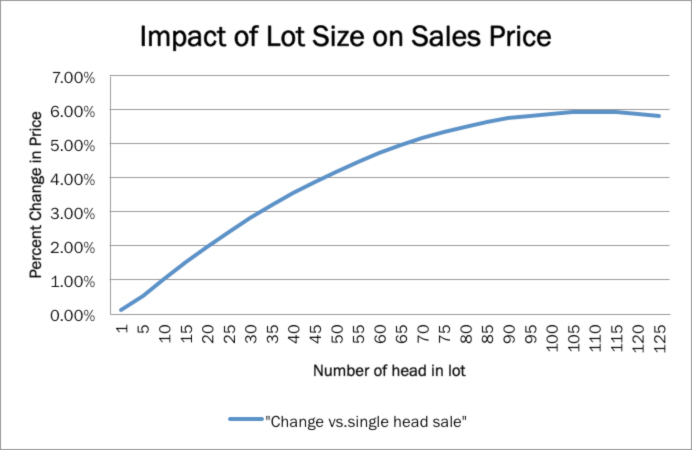 Effigy iv. Effect of lot size on sales cost. Source: "Factors Affecting Feeder Cattle Prices in Kansas and Missouri." Kansas State University Extension 2010.
Georgia cattle producers have several market outlets. No one organisation fits every producer?south needs, and so there volition continue to exist many alternatives. The marketplace outlets bachelor to you will depend on the number and uniformity of cattle you take to sell at one time. This by and large is the key ingredient in gaining higher prices through different marketing methods. Effigy four shows the cost premiums that larger compatible groups of similar cattle could be expected to bring. This chart is based on survey data collected from Kansas sale markets.
The right manner to interpret this chart would be to compare the values reflected by the line to a base price for a single-caput sale. For example, if a single-caput lot were expected to bring $125/Cwt., a semi-trailer load would be expected to bring 5 percent, or $6.25, more. Every bit the number of caput in the lot increases to more than than 100 caput, the increment begins to decline, but it is yet larger than the base.
Essentially, the ability to class truckload lots (around 48,000 pounds) of uniform cattle will mostly result in even higher prices and open upwardly marketing methods beyond the unmarried-head auction.
No matter your size herd, you can capture some of these benefits by having a defined, curt convenance season so your calves volition be compatible in weight. Uniformity in cattle color and form will be a product of your breeding herd. Lack of uniformity in cattle color tin can become a trouble if not properly planned in the crossbreeding system.
Choose the Right Marketing Method
Some of Georgia's cattle market place alternatives, along with their advantages and disadvantages, are described in this section.
Sale Markets
Auctions are the traditional way of selling livestock. About auction markets hold their sales on a item day of the week.
Auction Market Advantages:
- The sale market place can provide competitive behest.
- Most markets are open 48-fifty weeks out of the year.
- It is convenient.
- Information technology is open to all sellers and buyers.
- In that location is prompt cash payment.
- All types of livestock tin be marketed.
- Information technology provides a place where cattle prices are determined and known to all.
- Information technology is supervised by the federal government.
- It requires admittedly no market place knowledge by the producer.
- It requires no minimum number of cattle.
Auction Marketplace Disadvantages:
- The seller has lilliputian control of prices.
- It encourages multi-handling, speculative-type trading.
- Overhead toll is loftier.
- Excessive stress and shrinkage of livestock may occur.
- At that place is a lack of volume and uniformity of animals at many markets.
- No permanent system exists for identifying livestock and producers later a sale.
- Producers may find it difficult to institute a reputation for selling high-quality, well-performing livestock.
- The grade and cost data can be hard to interpret.
- Prices are uncertain.
- Affliction spread is more likely.
- The number of buyers may be small, reducing competitiveness of behest.
Even when marketing through auctions, prices for cattle are not uniform. Nonetheless, you can accept some influence on the toll you go by communicating with your auction operator. Detect out before yous evangelize your cattle what the operator expects in buyers and cattle numbers to exist sold during diverse marketing times. Allow the operator know ahead of time what you will be bringing to market. If y'all have a grouping of uniform calves to sell, enquire most the possibility of selling as a group.
Graded and Pooled Sales
Graded and pooled selling is the combination of small-scale lots of livestock into larger, compatible lots of animals. This tin can be washed informally past people "pooling" their animals before selling or through more formal arrangements. For case, area livestock producers may organize to develop a graded and pooled sale.
Pooled Sale Advantages:
- Tin put large, economical lots of livestock together.
- Cost savings for buyers are passed along to sellers.
- Large numbers of livestock attract more than buying competition.
Pooled Sale Disadvantages:
- Grading, sorting, weighing and penning before auction tin be time-consuming and expensive.
- Individual producers lose their identity.
- Many marketing facilities may non exist designed for efficient processing for this system.
- It's hard to get a big number of producers to concord on all terms of sale.
Tele-Auctions
A tele-auction is the use of a telephone briefing phone call to let separation of livestock, buyers and the sale process. Producers with truckload lots of cattle can exist sold direct from the subcontract. Producers with partial truckloads can be matched with other producers "on newspaper" and sold together. The tele-auction could too be used with a pooled arrangement for smaller producers.
Georgia producers have a long history of using feeder cattle tele-auctions. In fact, Georgia cattlemen have been using tele-auctions since 1977. Since that fourth dimension, advances in engineering accept made it possible to utilize videos in the marketing of cattle. Even so, many marketing agencies notwithstanding use the telephone when taking bids for cattle.
Tele-Auction Advantages:
- Potentially increases contest.
- Direct heir-apparent-to-seller transportation reduces stress, shrinkage and expiry loss.
- Reduces buyer and marketing cost.
Tele-Auction Disadvantages:
- Requires prior producer commitment.
- Reduces marketing flexibility.
- Requires partial or full truckload lots.
Video Auctions
Video auctions are very similar to tele-auctions except that videos of the cattle are made for advance viewing or for viewing by satellite telecast while the cattle are sold. Other than that betoken, many of the considerations for tele-auctions also utilize to video auctions.
Digital recordings are oftentimes used in combination with tele-auctions. Video auctions were once exclusively sponsored by national companies; however, in recent years many local sale markets every bit well as some regional marketing agencies take gone to marketing load-lots of cattle using video auctions. Regardless of the size of the marketing agency, video or tele-auctions permit buyers to select from hundreds or thousands of cattle coming from a broad geographic area in a brusque period of time, which reduces transportation costs and health risks.
Video Sale Advantages:
- Largest number of potential buyers of all market methods.
- Potential for reduced heir-apparent cost passed along to seller.
- Straight buyer-to-seller transportation.
- Commitment schedules are very flexible. For instance, cattle can be sold in July for delivery in Oct.
Video Auction Disadvantages:
- Marketing toll can be generally higher than tele-auction.
- Requires producer to have on-farm truckload (and preferably more) of compatible cattle.
Private Treaty
DIRECT SELLING TO CONSUMERS:
Many producers look to meliorate their bottom line by marketing
straight to consumers. Direct-marketing can be a way to add
value and increment profits. It as well involves additional production
risk, expense and management.
While a total give-and-take of straight marketing is beyond the scope of
this publication, producers interested in this possibility should
consider non only the current value of the animals, simply too
the additional production costs and chances for death loss. They
should also have a very practiced handle on their target market
and know what this marketplace will pay and compare that price to
the overall breakeven price.
Individual treaty selling of livestock was widely used in the early 1920s when many country buyers operated throughout the land. Every bit auctions became more prevalent, producers shifted to auction selling. Private treaty selling is a closed-sale method; it is a private negotiation betwixt seller and heir-apparent. The toll and terms of sale are usually known only by the seller and heir-apparent.
Sellers and producers of breeding stock have used this method for centuries and continue to use it. Producers with large herds frequently use this method. Individual treaty selling of cattle is increasing considering many buyers prefer to have their calves conditioned to their specifications and prefer to buy from sellers whose product practices come across their needs and demands.
Private Treaty Advantages:
- Seller controls the marketing process.
- Costs less than other marketing methods.
- Producer can constitute a reputation.
- Animals are farm fresh with no stress.
- Disease spread is minimal.
- Producer can condition animals to buyer specifications.
Private Treaty Disadvantages:
- Requires fantabulous marketing noesis past seller.
- There is no supervision by the federal government.
- Producer assumes risk of payment collection.
- May be petty or no buyer competition.
Retained Ownership
Retained ownership involves property cattle longer than would usually be the case or to the next one or two stages of production. In other words, if yous are a cow-calf producer, y'all retain buying of your cattle through the stocker stage, and if you are a stocker operator, you retain ownership in the feedlot phase of production. There is likewise the option to retain buying all the way from nascency to harvest. In that location are many factors that should be considered before retaining ownership of calves. Each cistron should be evaluated by each producer for each state of affairs. Adding of intermission-even costs under different retained ownership alternatives will assist the producer judge profit potential.
Retained Buying Advantages:
- Receive a return for value-added direction and use of superior genetics.
- Receive data (carcass and feeding operation) back to be utilized.
Retained Ownership Disadvantages:
- Increased run a risk associated with market conditions, cattle performance and production.
- Postponement of revenue.
- Additional time, labor and involvement costs.
- Requires some knowledge of operation capabilities of calves.
Branded Beefiness Programs
Branded beef programs guarantee a consumer a prepare of standards (e.yard., lean, natural, organic, brood-specific, grain-fed, grass-fed, tender, etc.). In general, branded beefiness programs tin be broken into 3 categories: brood-specific branded programs choose cattle from a specific breed or brood type; company-specific programs choose beef from all breeds only include other criteria in terms of grade, marbling, size, types of feed used and/or restrictions on the utilize of pesticides, antibiotics and hormones; and store-branded beef, which is exactly as the name describes. Some grocery store bondage are at present branding their own beefiness products. Most programs tin can be farther classified into ane of three groups: light/lean beefiness, organic and/or natural beefiness, and high-palatability beef.
Branded Beef Advantages:
- Branded beef companies volition pay premium for specific cattle.
- Producers are rewarded for management practices and/or herd genetics.
- Increased power for the producer to establish a reputation.
Branded Beefiness Disadvantages:
- Requires producer to switch from "selling" to "marketing" cattle.
- Good record keeping arrangement must be established.
- May crave additional input costs to meet program requirements.
- Potential performance and morbidity (losses from health problems) from producing natural/organic cattle.
When to Market
In addition to providing the right product at the right place, profitable marketers also market at the correct fourth dimension. Prices for cattle are influenced past supply and need, which fluctuate throughout the year. These fluctuations are usually somewhat predictable; therefore, acute stockmen tin use these tendencies to develop a profitable marketing plan.
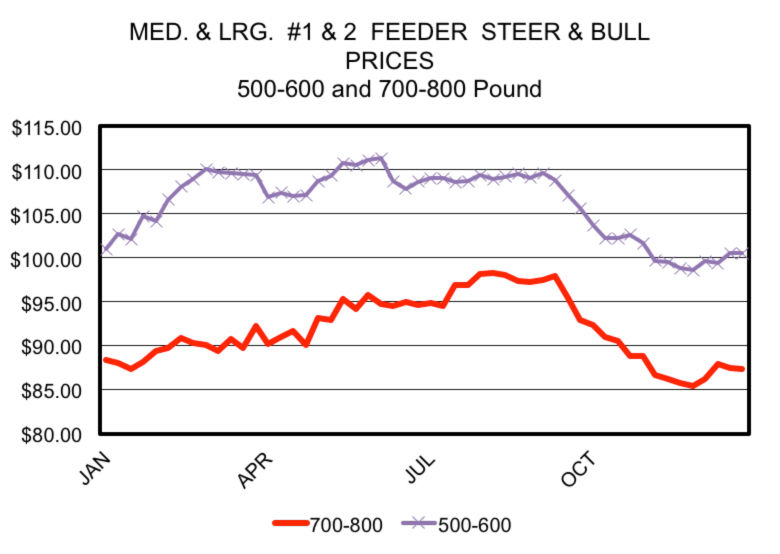
 Effigy v. Seasonal cost indices for steers and bulls in Georgia sale markets.
Figure v shows the relative prices for 500-600 and 700-800 pound steers and bulls in Georgia auction markets. The lines on the nautical chart reflect price indices or relative prices throughout the year. By using 100 percent as the average for the year, interested cattlemen can make some inferences about the way prices typically behave. For instance, from 2007-2011, prices for 500-600 pound steers and bulls sold in March were 6 percent higher than the yearly average. On the other hand, prices for the aforementioned calves in November were eight percent below the annual average.
It is important to notation that the indices change for different weight classes. For case, prices for 500-600 pound calves tend to peak in the spring and then pass up the balance of the year. Conversely, prices for 700-800 pound feeders tend to gradually increase throughout the yr and peak in July and August. In both instances, prices tend to be lowest in the autumn.
Consider not but the highest (or lowest) prices, only as well the price of product. For instance, even though 500- 600 pound calf prices peak in the spring, it may exist more cost effective to actually sell the calves afterward in the summer. The implication is that cattlemen should practise their homework on not merely when prices are the highest and lowest, simply also on what the associated price of production is.
The actual price received past near dogie producers for their calves will be adamant when they sell their cattle at a specific market. This demand not be the case for producers who have well-nigh-truckload lots of cattle to sell at one fourth dimension. These producers tin prepare a price before they will actually sell their cattle by using the feeder cattle futures market. By using the feeder cattle options market place, producers as well tin can set a minimum cost they volition have for their cattle earlier the actual sell date. Both the feeder cattle futures and option contracts are traded on the Chicago Mercantile exchange. By trading a 50,000-pound contract, a cattle producer in Georgia tin can set the price for as much as a year in advance of the time he or she actually sells cattle.
Producers who volition be selling shut to the fifty,000-pound contract size at in one case may desire to investigate these pricing alternatives if they need to reduce the risk of unfavorable toll changes. Producers keeping cattle through stockering, and particularly those feeding cattle, are encouraged to consider forrad pricing alternatives as they are nearly susceptible to curt-term toll changes.
Feeder Cattle Market Alternatives Summary
Near Georgia cattle producers accept several alternatives for when, where and how they market their cattle. Consider each of these alternatives separately in low-cal of its advantages and disadvantages.
No one combination of alternatives can be considered a superior cattle marketing program for all farms. What works for i producer may not necessarily work for another. Even so, in that location can be no doubt that proper attention to a marketing program tin can pay great dividends.
Keeping Up with the Market place
Successfully implementing a cattle marketing program will crave the producer to keep tabs on the market, particularly when a market conclusion is at hand.
The following is a list of price and important supply reports that may be useful.
Price Reports by Phone
Georgia and national cattle market place prices, updated daily, Federal State Market News, Thomasville, Ga. 229-226-1641.
Published Price Reports
About toll reports are now available online or via email subscription. Yet, the Georgia Department of Agriculture's Livestock Market News office in Thomasville, Ga., however delivers the daily and weekly auction reports via a recorded message. This information is available by calling 229-226-1641.
Many reports can be accessed through the Southeast Cattle Advisor website at www.secattleadvisor.com. Specific market place reports tin can be obtained via email subscription through USDA's Agriculture Market News at http://usda.mannlib.cornell.edu/MannUsda/homepage.do
Weekly, monthly or almanac production information such as cattle inventory numbers, cattle slaughter and beef production tin be obtained at the USDA National Agricultural Statistics Service (NASS) website at www.nass.usda.gov
References
Schulz, Lee, D. Dhuyvetter, K. Harborth, and Waggoneer. "Factors Affecting Feeder Cattle Prices in Kansas and Missouri." Kansas Land University Department of Agricultural Economics, 2010. Available online at www.agmanager.info.
Troxel, Tom, et al. "Improving the Value of Feeder Cattle." Arkansas Cooperative Extension, FSA 3056 (2011). Academy of Georgia. "2012 Beefiness Cow-calf Budgets." Agricultural and Applied Economics Department. Available online at www.secattleadvisor.com.
U.Due south. Department of Agriculture-Agricultural Market Service (AMS). "Georgia Weekly Sale Report, TV_ LS145" (various weeks).
U.S. Department of Agriculture, Livestock and Seed Program. "United states of america Grades of Feeder Cattle." Effective date October one, 2000.
U.Due south. Department of Agronomics, National Agricultural Statistics Service (USDA-NASS). "Cattle Report 2012." Washington DC, January 2012.
 For more information on beefiness cattle marketing and economics, visit the Southeast Cattle Advisor website at world wide web.secattleadvisor.com
Status and Revision History
Published on Jun 01, 2001
In Review for Major Revisions on May 15, 2009
Published on Dec 08, 2010
Published with Major Revisions on Jul thirty, 2012
Published with Total Review on Jan thirty, 2017
stodartnesintlefor.blogspot.com
Source: https://extension.uga.edu/publications/detail.html?number=B1078&title=Profitable+Cattle+Marketing+for+the+Cow-Calf+Producer
0 Response to "How Much Do You Averagte Making Selling Beef Cattle 2017"
Post a Comment