what did elliott smith tune his acoustic to
| Elliott Smith | |
|---|---|
 Smith performing in 2003 | |
| Background information | |
| Birth name | Steven Paul Smith |
| Born | (1969-08-06)August 6, 1969 Omaha, Nebraska, U.S. |
| Origin | Portland, Oregon, U.Due south. |
| Died | October 21, 2003(2003-x-21) (anile 34) Echo Park, Los Angeles, California, U.S. |
| Genres |
|
| Occupation(s) |
|
| Instruments |
|
| Years active | 1991–2003 |
| Labels |
|
| Associated acts |
|
| Website | elliottsmith |
Steven Paul Smith (August six, 1969 – October 21, 2003), known professionally every bit Elliott Smith, was an American vocaliser-songwriter and multi-instrumentalist. Smith was built-in in Omaha, Nebraska, raised primarily in Texas, and lived much of his life in Portland, Oregon, where he first gained popularity. Smith's chief instrument was the guitar, though he also played piano, clarinet, bass guitar, drums, and harmonica. Smith had a distinctive vocal style, characterized by his "whispery, spiderweb-thin delivery",[five] and often used multi-tracking to create vocal layers, textures, and harmonies.
After playing in the rock band Heatmiser for several years, Smith began his solo career in 1994, with releases on the independent record labels Cavity Search and Kill Rock Stars (KRS). In 1997, he signed a contract with DreamWorks Records, for which he recorded two albums.[half-dozen] Smith rose to mainstream prominence when his song "Miss Misery"—included in the soundtrack for the moving picture Good Will Hunting (1997)—was nominated for an Oscar in the All-time Original Song category in 1998.[seven]
Smith was a heavy drinker and drug user at times throughout his life, and was diagnosed with attending deficit hyperactivity disorder (ADHD) and low. His struggles with drugs and mental illness affected his life and work, and often appeared in his lyrics. In 2003, aged 34, he died in Los Angeles, California, from two stab wounds to the chest.[8] The autopsy evidence was inconclusive as to whether the wounds were self-inflicted or the event of homicide.[ix] At the time of his death, Smith was working on his sixth studio album, From a Basement on the Colina, which was posthumously produced and released in 2004.
Early life
Steven Paul Smith was built-in at the Methodist Hospital in Omaha, Nebraska, the only child of Gary Smith, a student at the University of Nebraska Medical Center, and Bunny Kay Berryman, an elementary school music teacher. His parents divorced when he was six months old, and Smith moved with his mother to Duncanville, Texas. Smith later had a tattoo of a map of Texas drawn on his upper arm and said: "I didn't become it because I similar Texas, kind of the opposite. But I won't forget virtually it, although I'g tempted to because I don't like it there."[ten]
Smith endured a difficult childhood[xi] and a troubled relationship with his stepfather Charlie Welch.[12] Smith stated he may accept been sexually abused by Welch at a young historic period, an accusation that Welch has denied.[11] [13] He wrote most this part of his life in "Some Song". The name "Charlie" also appears in songs "Flowers for Charlie" and "No Confidence Homo." In a 2004 interview, Jennifer Chiba, Smith's partner at the time of his decease, said that Smith's hard babyhood was partly why he needed to sedate himself with drugs as an adult: "He was remembering traumatic things from his childhood – parts of things. It's not my place to say what."[eleven]
For much of his babyhood, Smith's family unit was a part of the Community of Christ[xiv] just began attention services at a local Methodist church. Smith felt that going to church did petty for him, except brand him "actually scared of Hell".[14] In 2001, he said: "I don't necessarily buy into any officially structured version of spirituality. Only I have my ain version of it."[15]
Smith began playing piano at historic period nine, and at ten began learning guitar on a small acoustic guitar bought for him by his male parent.[16] At this historic period he composed an original piano piece, "Fantasy", which won him a prize at an arts festival.[15] Many of the people on his mother'south side of the family unit were not-professional musicians; his granddaddy was a Dixieland drummer, and his grandmother sang in a glee order.[15]

Smith graduated from Lincoln High School in Portland, Oregon.
At fourteen, Smith left his female parent's home in Texas and moved to Portland, Oregon, to alive with his father, who was then working every bit a psychiatrist. Information technology was effectually this time that Smith began using drugs, including booze, with friends. He also began experimenting with recording for the beginning time after borrowing a four-runway recorder.[15] At high school, Smith played clarinet in the school band and played guitar and piano; he also sang in the bands Stranger Than Fiction[12] and A Murder of Crows,[17] billed every bit either Steven Smith or "Johnny Panic".[18] He graduated from Lincoln Loftier School as a National Merit Scholar.[19]
Subsequently graduation, Smith began calling himself "Elliott", saying that he thought "Steve" sounded likewise much like a "jock" name, and that "Steven" sounded "too bookish".[19] According to friends, he had also used the pseudonym "Elliott Stillwater-Rotter" during his time in the band A Murder of Crows.[20] Biographer Due south. R. Shutt speculates that the name was either inspired past Elliott Avenue, a street that Smith had lived on in Portland, or that it was suggested past his then-girlfriend. A inferior high associate of Smith speculates Smith changed his name so as non to be confused with Steve Smith, the drummer of Journey.[21]
Career
1991–1996: Heatmiser
In 1991 Smith graduated from Hampshire College in Amherst, Massachusetts with a degree in philosophy and political scientific discipline. "Went straight through in 4 years", he explained to Under the Radar in 2003. "I guess information technology proved to myself that I could do something I really didn't want to for four years. Except I did like what I was studying. At the time it seemed like, 'This is your one and only take a chance to become to college and you had just amend do information technology because some mean solar day you might wish that you did.' Plus, the whole reason I applied in the first identify was because of my girlfriend, and I had gotten accepted already even though we had broken up earlier the offset mean solar day."[16] Later on he graduated, he "worked in a bakery back in Portland with a bachelor'due south degree in philosophy and legal theory".[16]
While at Hampshire, Smith formed the band Heatmiser with classmate Neil Gust.[22] After Smith graduated from Hampshire, the band added drummer Tony Lash and bassist Brandt Peterson and began performing around Portland in 1992.[23] The group released the albums Expressionless Air (1993) and Cop and Speeder (1994) as well as the Yellow No. 5 EP (1994) on Frontier Records.[23] They were so signed to Virgin Records to release what became their final album, Mic City Sons (1996).[24]
Around this time, Smith and Gust worked a number of odd jobs effectually Portland, including installing drywall, spreading gravel, transplanting bamboo copse, and painting the roof of a warehouse with heat reflective pigment. The pair were besides on unemployment benefits for some time, which they considered an "creative person grant".[25]
Smith had begun his solo career while notwithstanding in Heatmiser, and the success of his first 2 releases created distance and tension with his band.[25] Heatmiser disbanded prior to the release of Mic City Sons, prompting Virgin to put the anthology out inauspiciously through its independent arm, Caroline Records.[24] A clause in Heatmiser'due south record contract with Virgin meant that Smith was still spring to it as an individual. The contract was later on bought out by DreamWorks prior to the recording of his 4th album, XO.[26]
1994: Roman Candle

In the early on 1990s, Smith'south girlfriend at the fourth dimension convinced him to ship a record of songs he had recently recorded on a borrowed four-track to Cavity Search Records.[25] Cavity owner Christopher Cooper asked to release the unabridged album of songs, which surprised Smith, as he was expecting only a deal for a seven-inch record.[ten] The album became Smith's release, Roman Candle (1994).[10]
Smith said: "I idea my head would exist chopped off immediately when it came out because at the time it was so reverse to the grunge matter that was popular ... The thing is that album was really well received, which was a total shock, and it immediately eclipsed [Heatmiser], unfortunately."[25] Smith felt his solo songs were not representative of the music Heatmiser was making: "The thought of playing [my music] for people didn't occur to me... because at the time information technology was the Northwest—Mudhoney and Nirvana—and going out to play an acoustic show was like crawling out on a limb and begging for information technology to be sawed off."[27]
One of Smith'southward outset solo performances was at the now-defunct Umbra Penumbra on September 17, 1994. Only three songs from Roman Candle were performed, with the majority of the ten-song set being B-sides, Heatmiser tunes and unreleased tracks.[28] The same yr, Smith released a split 7-inch record with Pete Krebs via Slo-Mo Records, contributing the track "No Confidence Man".[29]
1995–1997: Elliott Smith and Either/Or
In 1995, Smith's cocky-titled anthology was released on Kill Stone Stars; the tape featured a style of recording similar to Roman Candle, but with hints of growth and experimentation.[ citation needed ] Though the majority of the album was recorded by Smith alone, friend and The Spinanes vocalist Rebecca Gates sang harmony vocals on "St. Ides Heaven", and Heatmiser guitarist Neil Gust played guitar on "Unmarried File". Several songs made reference to drugs, just Smith explained that he used the theme of drugs as a vehicle for conveying dependence rather than the songs beingness about drugs specifically.[30] Looking back, Smith felt that the album's pervasive mood gave him "a reputation for being a actually dark, depressed person" and said that he afterwards made a conscious move toward more diverse moods in his music.[31]

Smith performing at Brownies, New York City in Apr 1997, shortly after the release of Either/Or
In 1996, filmmaker Jem Cohen recorded Smith playing audio-visual songs for the short moving picture Lucky Three: An Elliott Smith Portrait.[32] Two of these songs would appear on his adjacent anthology, Either/Or, which was another Kill Rock Stars release. Either/Or came out in 1997 to favorable reviews.[33] The album plant Smith venturing farther into total instrumentation, with several songs containing bass guitar, drums, keyboards, and electric guitars, all played by Smith. The album title was derived from the two-volume book of the aforementioned name by Danish philosopher Søren Kierkegaard, whose works generally deal with themes such as existential despair, angst, decease, and God.[ citation needed ]
By this time, Smith's already-heavy drinking was being compounded with utilize of antidepressants.[34] At the end of the Either/Or bout, some of his close friends staged an intervention in Chicago,[34] just it proved ineffective.[xi] Before long after, Smith relocated from Portland to Bailiwick of jersey City, New Jersey, and after Brooklyn, New York.[35]
1997–98: "Miss Misery" and the Oscars
In 1997, Smith was selected past manager and fellow Portland resident Gus Van Sant to exist a part of the soundtrack to his pic, Skilful Volition Hunting. Smith recorded an orchestral version of "Between the Bars" with composer Danny Elfman for the film. Smith also contributed a new song, "Miss Misery", and iii previously released tracks ("No Name #3", from Roman Candle, and "Angeles" and "Say Yeah", from Either/Or). The motion picture was a commercial and critical success, and Smith was nominated for an Academy Award for "Miss Misery". Not eager to step into the limelight, he agreed to perform the vocal at the ceremony only later on the producers informed him that if he was unwilling to perform, they would choose someone else to play it.[25] [ failed verification ]
On March 5, 1998, Smith made his network television debut on Belatedly Night with Conan O'Brien performing "Miss Misery" solo on audio-visual guitar.[36] A few days later, wearing a white suit, he played an abridged version of the song at the Oscars, accompanied past the house orchestra. James Horner and Will Jennings won the award that nighttime for all-time song with "My Heart Will Go On" (sung by Celine Dion) from the film Titanic. Smith did not vocalism disappointment about not winning the award.[37]
Smith commented on the surrealism of the Oscars experience: "That'southward exactly what it was, surreal... I relish performing well-nigh as much equally I enjoy making up songs in the first place. But the Oscars was a very foreign show, where the set was merely one song cut down to less than 2 minutes, and the audience was a lot of people who didn't come to hear me play. I wouldn't want to live in that earth, but it was fun to walk around on the moon for a day."[38]
1998–2000: XO and Effigy 8
In 1998, after the success of Either/Or and "Miss Misery", Smith signed to a bigger record label, DreamWorks Records. Around the same time, Smith barbarous into depression, speaking openly of because suicide,[34] and on at least i occasion[xi] made a serious attempt at ending his own life.[39] While in North Carolina, he became severely intoxicated and ran off a cliff. He landed on a tree, which desperately impaled him merely broke his autumn.[eleven] When questioned most his suicide attempt, he told an interviewer, "Aye, I jumped off a cliff, but let's talk well-nigh something else."[35]
Christopher Cooper, head of Cavity Search Records (which released Roman Candle), said about this time in Smith'southward life, "I talked him out of thinking that he wanted to kill himself numerous times when he was in Portland. I kept telling him that he was a brilliant human being, and that life was worth living, and that people loved him."[34] Pete Krebs also agreed: "In Portland we got the brunt of Elliott's initial depression... Lots of people have stories of their ain experiences of staying up with Elliott 'til five in the morning time, holding his hand, telling him not to impale himself."[35]
Smith's first release for DreamWorks was afterwards that year. Titled XO, it was conceived and developed while Smith wrote information technology out over the winter of 1997/1998, dark afterwards night seated at the bar in Luna Lounge. Information technology was produced by the team of Rob Schnapf and Tom Rothrock. XO too independent some instrumentation from Los Angeles musicians Joey Waronker and Jon Brion. It contained a more full-sounding, bizarre pop sound than any of his previous efforts, with songs featuring a horn section, Chamberlins, elaborate string arrangements, and even a pulsate loop on the song "Independence Solar day". His familiar double-tracked vocal and acoustic guitar way were still apparent while his somewhat personal lyrical style survived. The album went on to top at number 104 on the Billboard 200[40] and number 123 on the Uk Album Charts,[41] while selling 400,000 copies[42] (more than double that of each of his ii Kill Stone Stars releases), becoming the best-selling release of his career.[43] Smith's bankroll band during most of this period was the Portland-based group Quasi, consisting of old bandmate Sam Coomes on bass guitar and Coomes'due south ex-wife Janet Weiss on drums. Quasi likewise performed as the opening act at many shows on the tour, with Smith sometimes contributing bass guitar, guitar, or backing vocals. On October 17, 1998, Smith appeared on Sabbatum Nighttime Live and performed "Waltz No. ii (XO)". His bankroll ring for this appearance was John Moen, Jon Brion, Rob Schnapf, and Sam Coomes.
In response to whether the change to a bigger record label would influence his creative control, Smith said, "I recall despite the fact that sometimes people wait at major labels equally simply coin-making machines, they're actually composed of individuals who are real people, and there'due south a function of them that needs to experience that part of their job is to put out expert music."[44] Smith also claimed in some other interview that he never read his reviews for fright that they would interfere with his songwriting.[45] It was during this menstruation that Smith appeared on Dutch goggle box in 1998 and provided a candid interview in which he spoke of his assessment of his music career until that bespeak:
Yeah, I don't know. I mean, I mostly only know things are different because people inquire me different questions, simply I don't feel like things are very changed. I mean, I still, I do the same things that I did before … I think about the same things, so … I'grand the wrong kind of person to be really big and famous.[46]
Equally function of the Dutch television special, Smith played alive versions of "Waltz No. 2 (XO)", "Miss Misery", and "I Didn't Sympathize"—the latter two songs were performed solely on piano, while the kickoff song was cut curt by Smith, as he explained: "I had to finish information technology because it's… you know, what's the point of playing a song badly? It'd be better to play information technology and mean information technology, than to merely walk through it."[46]
Smith relocated from Brooklyn to Los Angeles in 1999,[35] taking up residence at a cabin in the Silverish Lake department of town, where he would regularly play intimate, audio-visual shows at local venues like Silverlake Lounge.[48] [49] He also performed in Toronto in April that year.[50] In the autumn, his cover of the Beatles' "Because" was featured in the end credits of DreamWorks' Oscar-winning drama American Beauty, and appeared on the film's soundtrack album.
The final anthology Smith completed, Effigy viii, was released on April xviii, 2000. It featured the return of Rothrock, Schnapf, Brion, and Waronker and was partially recorded at Abbey Road Studios in England, with an obvious Beatles influence in the songwriting and production. The anthology garnered favorable reviews,[51] and peaked at number 99 on the Billboard 200[40] and 37 on the UK Album Charts.[41] The album received praise for its ability popular way and complex arrangements, described equally creating a "sweeping kaleidoscope of layered instruments and sonic textures".[47] However, some reviewers felt that Smith's trademark dark and melancholy songwriting had lost some of its subtlety, with i reviewer likening some of the lyrics to "the cocky-pitying complaints of an adolescent venting in his diary".[52]
Anthology art and promotional pictures from the catamenia showed Smith looking cleaned-upward and put-together. An extensive tour in promotion of the tape ensued, book-concluded by television appearances on Late Night with Conan O'Brien and the Late Bear witness with David Letterman. Yet, Smith's condition began to deteriorate as he had become addicted to heroin either towards the end of or just after the Effigy 8 tour.[11]
2001–2002: Addiction and scrapped recordings
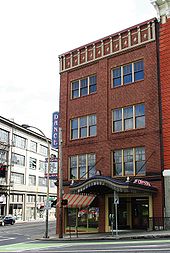
The Crystal Ballroom music venue in Portland, Oregon. One of Smith's performances here in December 2001 drew business organization from a reviewer.
Around the time he began recording his last album, Smith began to display signs of paranoia, often assertive that a white van followed him wherever he went.[53] He would have friends drop him off for recording sessions near a mile away from the studio, and to reach the location, he would trudge through hundreds of yards of brush and cliffs. He started telling people that DreamWorks was out to get him: "Not long ago my house was broken into, and songs were stolen off my figurer which accept wound up in the easily of sure people who work at a sure label. I've also been followed around for months at a fourth dimension. I wouldn't fifty-fifty want to necessarily say information technology's the people from that label who are post-obit me around, merely it was probably them who bankrupt into my house."[25] During this menstruum, Smith hardly ate, subsisting primarily on water ice cream. He would go without sleeping for several days and and so sleep for an entire twenty-four hours.[ citation needed ]
A follow-up to Smith'due south 2000 album was originally planned to happen with Rob Schnapf, but their sessions were abandoned. Smith also began distancing himself from managing director Margaret Mittleman, who had handled him since the Roman Candle days.[11] He finally began recording a new album with only himself and Jon Brion equally producers sometime during 2001. The pair had recorded a substantial amount of music for the album when Brion stopped the sessions because of Smith's struggle with substance use disorder.[54] Their friendship promptly ended, and Smith scrapped all of their work until that signal. He after said "There was even a little more than half of a record done before this new 1 that I just scrapped considering of a blown friendship with someone that fabricated me so depressed I didn't want to hear any of those songs. He was just helping me record the songs and stuff, and then the friendship kind of fell apart suddenly one day. Information technology just fabricated it kind of awkward being alone in the car listening to the songs."[25]
When Brion sent a bill for the abased sessions to DreamWorks, executives Lenny Waronker and Luke Wood scheduled a meeting with Smith to determine what went wrong with the sessions. Smith complained of intrusion upon his personal life from the characterization, as well equally poor promotion for the Figure 8 anthology. The talks proved fruitless, and before long later, Smith sent a message to the executives, stating that if they did not release him from his contract, he would have his own life.[11] In May 2001, Smith set out to re-record the album, generally on his ain, but with some help from David McConnell of Goldenboy. McConnell told Spin that, during this time, Smith would smoke over $1,500 worth of heroin and crack per twenty-four hour period, would often talk about suicide, and on numerous occasions tried to give himself an overdose.[55] Steven Drozd of The Flaming Lips and Scott McPherson of Sense Field played a few drum tracks, Sam Coomes contributed some bass guitar and bankroll vocals, only almost every other instrument was recorded past Smith.[ citation needed ]
Smith's song "Needle in the Hay" was included in Wes Anderson'south 2001 dark comedy film The Royal Tenenbaums during a suicide attempt scene. Smith was originally supposed to contribute a embrace of The Beatles' "Hey Jude" for the picture show, just when he failed to do then in time, Anderson had to use The Mutato Muzika Orchestra's version of the runway instead.[56] Anderson would later say that Smith "was in a bad country" at the fourth dimension.[56] [ failed verification ]
Smith's alive performances during 2001 and 2002 were infrequent, typically in the Pacific Northwest or Los Angeles. A review of his December 20, 2001, bear witness at Portland'southward Crystal Ballroom expressed business over his appearance and performance: his hair was uncharacteristically greasy and long, his face up was bearded and gaunt, and during his songs he exhibited alarming signs of "memory-loss and butterfingers".[57] At another performance in San Francisco that month, the audience began shouting out lyrics when Smith could not remember them.[58]
In the first of merely three concerts performed in 2002, Smith co-headlined Northwestern University's A&O Ball with Wilco on May 2 in Chicago.[59] He was onstage for well-nigh an hour but failed to complete half of the songs.[13] [60] He claimed that his poor functioning was due to his left mitt having fallen asleep and told the audition it felt "like having stuff on your hand and y'all can't get it off".[13] Smith'due south performance was reviewed as "undoubtedly one of the worst performances ever by a musician"[61] and an "excruciating […] nightmare".[62] A reporter for the online mag Glorious Noise wrote, "It would not surprise me at all if Elliott Smith ends up dead inside a year."[63]
On November 25, 2002, Smith was involved in a ball with the Los Angeles Police force Department at a concert where The Flaming Lips and Brook were performing.[64] Smith later said he was defending a man he idea the constabulary were harassing.[ citation needed ] The officers allegedly beat and arrested him and girlfriend Jennifer Chiba. The ii spent the dark in jail. Smith's back was injured in the incident, causing him to cancel a number of shows.[25] Wayne Coyne, lead singer of The Flaming Lips and a friend of Smith's, stated concern over Smith's appearance and actions, saying that he "saw a guy who had lost control of himself. He was needy, he was grumpy, he was everything you wouldn't want in a person. It's not like when you lot think of Keith Richards existence pleasantly blissed out in the corner."[65]
2003: Reemergence and From a Basement on the Hill

1 of Smith's concluding performances in New York Metropolis at the Lit Lounge in January 2003. He played Knitting Factory & North Six in June 2003.
Smith had attempted to become to rehab several times, but constitute that he was unable to chronicle to the popular treatments for people with substance use disorder that used a twelve-footstep programme basis for treatment. "I couldn't do the kickoff stride […] I couldn't say what you lot were supposed to say and hateful it."[25] In 2002, Smith went to the Neurotransmitter Restoration Center in Beverly Hills to start a form of treatment for substance apply disorder. In 1 of his final interviews, he spoke nearly the middle, "What they exercise is an Four treatment where they put a needle in your arm, and you're on a baste handbag, simply the just thing that'due south in the baste pocketbook is amino acids and saline solution. I was coming off of a lot of psych meds and other things. I was even on an antipsychotic, although I'm not psychotic."[25]
Two sold-out solo acoustic concerts at Hollywood's Henry Fonda Theater, on January 31 and February i, 2003, saw Smith attempting to reestablish his credibility equally a alive performer. Before the bear witness, Smith scrawled "Kali – The Destroyer" (the Hindu goddess associated with time and change) in big block letters with permanent ink on his left arm, which was visible to the oversupply during the operation.[66] [67] On several songs, he was backed by a stripped-down drum kit played past Robin Peringer (of the band 764-HERO), and members of opening band Rilo Kiley contributed bankroll vocals to one song. Near the terminate of the first show, the musician responded for several minutes after a heckler (afterwards identified equally Smith's ex-girlfriend Valerie Deerin) yelled "Go a backbone."[23] [68] Smith played two more Los Angeles concerts during 2003, including The Derby in May and the L.A. Weekly Music Awards in June.[69]
After his 34th birthday on Baronial 6, 2003, he gave up booze. Manager Mike Mills had been working with Smith during his final years and described Smith's troubles and credible recovery: "I gave the script to him, then he dropped off the confront of the earth […] he went through his whole crazy time, but by the time I was done with the moving picture, he was making From a Basement on the Loma and I was shocked that he was actually making music."[lxx]
With things improving for Smith after several troubled years, he began experimenting with dissonance music and worked on his girlfriend Jennifer Chiba'due south iMac with the intent of learning how to record with computers, noting that information technology was the only method with which he was however unfamiliar.[25] Smith jokingly labeled his experimental manner of recording "The California Frown" (a play on the Beach Boys' "California Sound").[71] He said of the songs, "They're kind of more than noisy with the pitch all distorted. Some are more acoustic, but in that location aren't too many like that. Lately I've just been making up a lot of racket."[25]
He was also in the process of recording songs for the Thumbsucker soundtrack, including Big Star's "Thirteen" and Cat Stevens'southward "Trouble".[seventy] In August 2003, Suicide Squeeze Records put out a limited-edition vinyl single for "Pretty (Ugly Before)", a song that Smith had been playing since the Figure eight tour.
Smith's final show was at Redfest at the University of Utah in Salt Lake City on September 19, 2003. The last vocal he played live was "Long, Long, Long" by The Beatles.
2004–nowadays: Posthumous releases

Joanna Bolme helped bring From a Basement on the Hill to completion in the wake of Smith's death.
From a Basement on the Hill, near iv years in production, was released on October 19, 2004, by ANTI- Records (a part of Epitaph Records). With Smith's family unit in control of his manor, they chose to bring in Rob Schnapf and Smith's ex-girlfriend Joanna Bolme to sort through the recordings and mix the album. Although Smith had voiced his want for it to exist a double anthology or a regular album with a bonus disc, it was non clear whether it would accept been possible for him to release it that way had he completed it.[25] As completed past Schnapf and Bolme, information technology was released as a 15-rail single anthology. Many songs from the sessions (afterwards leaked onto the Cyberspace) were not included, such as "True Dear", "Everything's OK", "Stickman", and "Suicide Car" (a reworking of the Figure eight-era unreleased instrumental "Tiny Time Car").[54] There has been unconfirmed speculation that Smith's family unit made the decision not to include some songs on the tape due to their lyrical content, although songs such equally "Rex's Crossing" that deal with darker subjects did make the album.[54] [72]
Elliott Smith and the Large Aught, a biography by Benjamin Nugent, was rushed to publication soon subsequently From a Basement on the Hill, shortly later the start ceremony of his decease. Smith's family, as well every bit Joanna Bolme, Jennifer Chiba, Neil Gust, Sam Coomes, and Janet Weiss, all declined to exist interviewed. It contained interviews with Rob Schnapf, David McConnell, and Pete Krebs. The book received mixed reviews, with Publishers Weekly remarking that while "Nugent manages to patch together the major beats of Smith's life, he can offer little meaningful insight".
In 2005, a tribute album, A Tribute to Elliott Smith, was released. It featured various bands performing tributes to Smith.[73]
On May viii, 2007, a posthumous 2-disc compilation anthology entitled New Moon was released by Kill Stone Stars. The album contained 24 songs recorded by Smith betwixt 1994 and 1997 during his tenure with the label, songs that were non included on albums, also as a few early versions and previously released B-sides. In the The states, the album debuted at number 24 on the Billboard 200, selling about 24,000 copies in its first week.[74] The record received favorable reviews[75] and was Metacritic's 15th best-reviewed album of 2007.[76] A portion of the proceeds from album sales were to go to Exterior In, a social service agency for low-income adults and homeless youth in Portland, Oregon.[77]
On October 25, 2007, a book titled Elliott Smith was released past Fall de Wilde,[78] which consists of photographs, handwritten lyrics, and "revealing talks with Smith's inner circle".[79] De Wilde was responsible for the Figure 8 sleeve fine art, making a landmark and de facto Smith memorial of the Solutions Audio mural. A five-song CD featuring previously unreleased live recordings of Smith performing acoustically at Largo in Los Angeles was included in the release.
Post-obit Smith's death, his estate licensed his songs for utilise in pic and tv set projects such as One Tree Hill, The Girl Adjacent Door, Georgia Rule, and Paranoid Park.
In a March 2009 interview, Larry Crane said that Smith's estate was defunct and all rights previously held by Smith are now in the control of his parents.[80] Crane went on to say that his parents own the rights to Smith's high schoolhouse recordings, some of the Heatmiser textile, all solo songs recorded until his 1998 record bargain with DreamWorks Records, and From a Basement on the Hill.[eighty] DreamWorks Records was acquired by Universal Music Group in 2003, and Interscope Records currently "owns all studio and live recording from January 1998 to his passing, except for the songs on From a Basement on the Hill."[80]
In Dec 2009, Impale Stone Stars announced that information technology had obtained the rights to re-release Roman Candle and From a Basement on the Loma, originally released past Cavity Search and ANTI-, respectively.[81] Roman Candle would be remastered past Larry Crane.[81] Forth with the press release, Impale Stone Stars posted a previously unreleased track of Smith's, titled "Cecilia/Amanda", as a complimentary download.[81] Roman Candle and From a Basement on the Loma were re-released on April 6, 2010, in the Us.[82]
A greatest hits compilation titled An Introduction to... Elliott Smith was released in November 2010 past Domino Records (UK) and Kill Rock Stars (US).
In Baronial 2013, there was a memorial concert in Portland, Oregon and three other cities. Attention the Portland show were several musicians Smith had performed with, friends, and an appearance past motion-picture show manager Gus Van Sant.[83]
In 2014, director Paul Thomas Anderson posted a video of the pilot episode for a show called The Jon Brion Evidence, featuring an acoustic set by Smith including accompaniment by Brion and pianist Brad Mehldau.[84]
On July 17, 2015, a documentary nigh Smith's life titled Heaven Adores Y'all saw a limited theatrical release. The documentary enlisted a number of close friends and family members, equally well equally hours of sound interviews throughout Smith's curt career. The film was directed by Nickolas Rossi and released through Eagle Rock Entertainment. Heaven Adores You received positive reviews from Consequence of Sound, The Guardian, and The Hollywood Reporter.[85] [86]
On August 6, 2019 (what would have been Smith's 50th birthday), UMe released digital deluxe editions of the ii albums XO and Figure 8. [87] The new edition of XO has nine added tracks, including Smith'south Oscar-nominated Good Will Hunting song "Miss Misery." Seven tracks have been added to Figure 8. The digital deluxe edition includes "Effigy 8"—Smith's embrace of the "Schoolhouse Stone!" song—which was originally released only on the Japanese edition of the anthology. The final runway on the new Effigy 8 edition is Smith'south encompass of the Beatles' "Because", originally featured on the 1999 American Beauty soundtrack.[87]
In May 2021, Smith's life and work were the subject of BBC Radio 4's Bang-up Lives.[88]
Death
Smith died on Oct 21, 2003, at the age of 34 from ii stab wounds to the chest.[8] At the time of the stabbing, he was at his Lemoyne Street domicile in Echo Park, California,[89] where he lived with his girlfriend, Jennifer Chiba. Co-ordinate to Chiba, the two were arguing,[42] and she locked herself in the bath to take a shower.[90] Chiba heard him scream and upon opening the door saw Smith standing with a knife in his chest. She pulled the knife out, after which he collapsed and she called 9-1-1 at 12:18 pm. Smith died in the hospital, with the fourth dimension of decease listed as i:36 p.m. A possible suicide note, written on a viscous note, read: "I'chiliad so deplorable—love, Elliott. God forgive me."[viii] In the coroner'southward written report of the note, the name "Elliott" is misspelled as "Elliot".[viii] While Smith'due south death was reported equally a suicide, the official dissection report released in Dec 2003 left open the question of homicide.[8]
Smith'due south remains were cremated, and his ashes were divided between his female parent, father, and half-sister Ashley.[23] A small memorial service for family unit and friends was held at his begetter's habitation in Portland, although Smith'southward "ashes weren't on manus because the coroner wouldn't release them."[23] The condition or location of Smith's ashes has not been fabricated public.
According to Pitchfork, tape producer Larry Crane reported on his Tape Op message board that he had planned to help Smith mix his album in mid-Nov. Crane wrote, "I hadn't talked to Elliott in over a year. His girlfriend, Jennifer, called me [last week] and asked if I'd like to come to L.A. and aid mix and finish [Smith's album]. I said 'yes, of grade', and chatted with Elliott for the starting time fourth dimension in ages. It seems surreal that he would call me to finish an album and then a week later kill himself. I talked to Jennifer this morning, who was evidently shattered and in tears, and she said, 'I don't empathize, he was then healthy.'"[91] The coroner reported that no traces of illegal substances or alcohol were constitute in Smith's system at the time of his death but did discover prescribed levels of antidepressant, anxiolytic, and ADHD medications, including clonazepam, mirtazapine, atomoxetine, and amphetamine.[92] In that location were no hesitation wounds, which are typically found on a victim of suicide by self-infliction.[42] Due to the inconclusive autopsy ruling, the Los Angeles Law Section's investigation remains open.[93]
Reaction

The memorial outside Solutions Audio in Los Angeles, California, in August 2006
Shortly later on Smith'south death, a fan memorial was initiated exterior Solutions Audio (4334 Dusk Boulevard, Los Angeles, California), the site at which the cover of the Figure 8 album was shot. Farewell messages to Smith were written on the wall, and flowers, photos, candles, and empty bottles of alcohol mentioned in Smith's songs were left. Since then, the wall has been a regular target for graffiti[94] only is regularly restored by fans.[ commendation needed ]
Memorial concerts were held in several cities in the United States and the United Kingdom.[71] A petition was soon put forth with intent to make part of the Silvery Lake area a memorial park in Smith'due south honour. It received over 10,000 signatures, merely no plans to plant the park have been announced.[71] A memorial plaque located inside Smith'southward former high schoolhouse, Lincoln High, was hung in July 2006.[95] The plaque reads: "I'k never going to know you at present, but I'thousand going to love yous anyhow" referencing Smith's song "Waltz No. 2 (XO)".

Memorial for Smith at the high school from which he graduated; lyrics from his song "Waltz No. 2 (XO)" are inscribed upon information technology.
Since Smith's death, many musical acts have paid him tribute. Songs in tribute to, or almost, Smith have been released past Pearl Jam ("Can't Continue" on the Live at Benaroya Hall concert album);[96] Sparta ("Bombs and Us");[71] Third Eye Blind ("There's No Hurry to Eternity", originally titled "Elliott Smith", on the Alive from Nowhere Virtually Y'all, Volume Ii: Pacific Northwest compilation); 9 Horses ("listening to the Elliott Smith discography in contrary order", on the album Perfectest Herald); Ben Folds ("Late" on Songs for Silverman);[97] Brad Mehldau ("Heaven Turning Gray (for Elliott Smith)" on Highway Passenger); Rilo Kiley ("It But Is", and "Ripchord" from the album More than Audacious); Lil B's 'The Worlds Ending';[98] Rhett Miller ("The Believer" on The Believer);[99] Earlimart ("Sky Adores You" on Treble and Tremble);[100] Joan Every bit Police Woman ("We Don't Ain Information technology" on Real Life);[101] and Pete Yorn ("Bandstand in the Sky" on Nightcrawler, a song jointly dedicated to Jeff Buckley).[102] Several tribute albums have too been released since his death, including Christopher O'Riley's 2006 Home to Oblivion: An Elliott Smith Tribute, with eighteen instrumental covers, The Portland Cello Projection's 2014 to e.south.,[103] covering six of his songs and To Elliott, from Portland containing covers past a number of Portland bands.
On July thirty, 2004, Chiba filed a lawsuit against the Smith family for 15% of his earnings (over $one million), claiming that she and Smith lived as "husband and wife",[104] that Smith had pledged to have care of her financially for the residual of her life, and that she worked as his manager and amanuensis from around 2000 until his decease.[105] A state labor commissioner ruled her claim as director to be invalid, as she had worked as an "unlicensed talent agent" nether California's Talent Agencies Human action. The case made it to the California appellate courtroom in October 2007, but the decision was affirmed ii–1.[106]
In an October 2013 Spin magazine article—a reflection at the ten-year anniversary of Smith'due south death—drummer McPherson stated that Smith was "a sick homo without his medicine" during the last 31 days of his life, when he was not merely sober, simply had besides given up carmine meat and sugar. In the same article, Chiba recalls thinking, "Okay, you're asking a lot of yourself. You're giving up a lot at in one case." Chiba further explained that "anyone who understands drug abuse knows that you use drugs to hide from your by or sedate yourself from stiff, overwhelming feelings. So when y'all're newly clean and coming off the medications that accept been masking all those feelings, that's when yous're the most vulnerable." Writing for Spin, Liam Gowing also encountered a local musician who claimed Smith had said to him: "The people who attempt to intervene, they're good people who genuinely care about you lot. Just they don't know what you're going through. Do what you lot need to practice." Co-ordinate to the musician, Smith had adamantly dissuaded him from suicide.[11]
Musical style and influences
Smith respected and was inspired by many artists and styles, including the Beatles, Neil Young, Simon & Garfunkel, Large Star,[107] the Clash,[30] the Who,[107] Led Zeppelin,[107] the Kinks,[108] Pink Floyd, Nick Drake, [107] Rush,[107] Bauhaus,[109] Elvis Costello,[110] Oasis,[111] Tv,[112] Motown and flamenco records,[xv] Ac/DC,[113] Hank Williams,[15] and Scorpions,[114] Smith claimed to mind exclusively to selected albums (such equally The Marble Index past Nico) for months.[113] Sean Croghan, a one-time roommate of Smith'due south, said that Smith "listened nearly exclusively to wearisome jams" in his senior year at college.[114] Smith likewise took inspiration from novels, faith, and philosophy. He liked archetype literature, particularly Samuel Beckett, T. S. Eliot, and Russian novelists such as Fyodor Dostoyevsky.[113]
Smith mentioned his admiration for Bob Dylan in several interviews, citing him as an early influence. He one time commented: "My father taught me how to play 'Don't Recall Twice, Information technology'south All Right'. I love Dylan's words, but even more than that, I love the fact that he loves words."[15] Smith covered Dylan's "When I Paint My Masterpiece" several times in concert. Smith has likewise been compared to folk singer Nick Drake, due to his fingerpicking style and vocals. Darryl Cater of AllMusic called references to "the definitive folk loner" Drake "inevitable",[115] and Smith'due south lyrics have been compared to those in Drake's minimalist and haunting final anthology.[116]
Smith was a dedicated fan of the Beatles (every bit well every bit their solo projects), once noting that he had been listening to them frequently since he was about "4 years quondam"[117] and also claimed that hearing The White Album was his original inspiration to become a musician.[113] In 1998, Smith contributed a embrace of the Beatles vocal "Because" to the closing credits and soundtrack of the film American Dazzler. Although this was the only Beatles song that Smith e'er officially released, he is known to accept recorded many others, ("Revolution", "I'll Be Back" and "I'm So Tired") and played many songs by both the band and the members' solo projects at live concerts.[118]
Smith said that transitions were his favorite part of songs and that he preferred to write broader, more impressionistic music closer to pop rather than folk music.[fifteen] Smith compared his songs to stories or dreams, not purely confessional pieces that people could relate to.[38] When asked about the dark nature of his songwriting and the cult following he was gaining, Smith said he felt it was merely a product of his writing songs that were strongly meaningful to him rather than annihilation contrived.[38] Larry Crane, Smith's posthumous archivist, has said that he was surprised at the amount of "recycling of musical ideas" he encountered while cataloging Smith's private tapes:[80] "I constitute songs recorded in high schoolhouse reworked 15 years on. Lyrics became more important to him equally he became older, and more time was spent working on them."[eighty]
Legacy
Since his death, Smith has been regarded as one of the virtually influential artists in indie music.[119] Many artists have mentioned Smith as their influence, such as Beck,[120] Phoebe Bridgers,[121] Julien Baker,[119] and Haim's atomic number 82 singer Danielle Haim.[122]
Run into as well
- List of unsolved deaths
Discography
- Studio albums
- Roman Candle (1994)
- Elliott Smith (1995)
- Either/Or (1997)
- XO (1998)
- Effigy 8 (2000)
Posthumous studio albums
- From a Basement on the Hill (2004)
Compilation albums
- New Moon (2007)
References
- ^ "CMJ's Elevation thirty Editorial Picks". CMJ New Music Report. New York City: CMJ Network, Inc. Jan 11, 1999. Retrieved August 13, 2016.
- ^ Hughes, Josiah (March 24, 2015). "Elliott Smith Md 'Heaven Adores You' Gets Limited Theatrical Release". Exclaim!. Ian Danzig. Retrieved Baronial 23, 2016.
- ^ "Mr. Misery". Out. United states: Here Publishing. May 2000. Retrieved August 13, 2016.
- ^ Adam Brent Houghtaling (August 7, 2012). This Will Cease in Tears: The Miserabilist Guide to Music. HarperCollins. p. 29. ISBN978-0-06-209896-two.
- ^ Huey, Steve. "Elliott Smith – Elliott Smith : Songs, Reviews, Credits, Awards". AllMusic. Retrieved April 17, 2013.
- ^ Schreiber, Ryan (March 31, 2000). "Elliott Smith: Effigy 8". Pitchfork . Retrieved December eight, 2015.
- ^ Grant, Jess (Nov nine, 2011). "Elliott Smith – Miss Misery". BitCandy . Retrieved Dec 8, 2015.
- ^ a b c d e "Rocker's Dissection Doesn't Rule Out Homicide". The Smoking Gun. January 8, 2004. Retrieved April 17, 2013.
- ^ Dansby, Andrew (December 31, 2003). "Smith Autopsy Inconclusive". Rolling Stone . Retrieved December 8, 2015.
- ^ a b c Shutt, S. R. "Elliott Smith: Biography – Page 6". Sweet Adeline . Retrieved December 8, 2015.
- ^ a b c d e f g h i j Gowing, Liam (December 2004). "Mr. Misery". Spin. Vol. 20, no. 12. pp. 80–92. Archived from the original on December 22, 2013. Retrieved April 17, 2013.
- ^ a b c Shutt, S. R. "Elliott Smith: Biography – Page 3". Sweetness Adeline . Retrieved December 8, 2015.
- ^ a b c Carpenter, Ellen (Oct 21, 2009). "'Why I Can't Listen to Elliott Smith'southward Music'". Spin . Retrieved December 8, 2015.
- ^ a b Nugent 2004, pp. 12–14.
- ^ a b c d due east f g h Shutt, S. R. "Elliott Smith: Biography – Page 2". Sweet Adeline . Retrieved December 8, 2015.
- ^ a b c Kagler, Marcus (2003). "UTR – Upshot iv". Under the Radar. Archived from the original on June 15, 2006. Retrieved April 17, 2013.
- ^ "Elliott Smith: A murder of crows". Sweet Adeline . Retrieved December 8, 2015.
- ^ "Recorded Music: Elliott Smith, 1969–2003". pushby.com. Oct 23, 2003. Archived from the original on November 18, 2006. Retrieved June 24, 2013.
- ^ a b Shutt, S. R. "Elliott Smith: Biography – Page 4". Sweet Adeline . Retrieved December 8, 2015.
- ^ Peschek, David (October 24, 2003). "Elliott Smith: Gentle singer with a fragile bulletin of brutality and despair". The Guardian . Retrieved December 8, 2015.
- ^ Pittman, Mark (2004). "Existence There". Being There. Archived from the original on February 17, 2005. Retrieved April 17, 2013.
- ^ Shutt, Due south. R. "Elliott Smith: Biography – Folio 5". Sweetness Adeline . Retrieved December eight, 2015.
- ^ a b c d e Schultz, William Todd (January 24, 2018). Torment Saint: The Life of Elliott Smith – William Todd Schultz – Google Libri. ISBN9781620403785. Archived from the original on January 24, 2018. Retrieved Jan 24, 2018.
{{cite book}}: CS1 maint: bot: original URL status unknown (link) - ^ a b "Heatmiser'south 'Mic City Sons' congenital a bridge to Elliott Smith's solo albums". Jan 24, 2018. Archived from the original on January 24, 2018. Retrieved January 24, 2018.
{{cite spider web}}: CS1 maint: bot: original URL status unknown (link) - ^ a b c d east f g h i j k fifty k Kagler, Marcus (June 2003). "Elliott Smith – Better Off Than Dead, Elliott Smith Comes Clean". Nether the Radar. Archived from the original on November five, 2003. Retrieved April 17, 2013.
- ^ "Keep the Things You Forgot: An Elliott Smith Oral History | Pitchfork". January 24, 2018. Archived from the original on January 24, 2018. Retrieved Jan 24, 2018.
{{cite web}}: CS1 maint: bot: original URL status unknown (link) - ^ Fritch, Matthew (September 1998). "Down on the Upside". Magnet (46). Retrieved April 17, 2013.
- ^ Elliott Smith Setlist at Umbra Penumbra, Portland
- ^ Minsker, Evan (April 26, 2016). "Elliott Smith'southward "No Confidence Human" Single Reissue Announced: Listen". Pitchfork . Retrieved March 2, 2020.
- ^ a b Shutt, S. R. "Elliott Smith: Biography – Folio seven". Sweet Adeline . Retrieved December viii, 2015.
- ^ Peisner, David. "Elliott Smith Interview: Well Rounded Entertainment". Well Rounded Entertainment. Archived from the original on September nineteen, 2000. Retrieved June 24, 2013.
- ^ "Up Close: Conversations with Filmmakers Presents Jem Cohen" (PDF). The Contained Film & Video Monthly. Foundation for Independent Video and Film. 22: 58. 1999. Retrieved Oct 25, 2021.
- ^ "Acclaimed Music – Either/Or". Acclaimed Music. Archived from the original on June 2, 2013. Retrieved April 17, 2013.
- ^ a b c d D'Angelo, Joe; Perez, Rodrigo. "mtvnews.com: Elliott Smith". MTV News. Archived from the original on November 26, 2012. Retrieved April 17, 2013.
- ^ a b c d Kelley, Brendan Joel (Oct thirty, 2003). "XO, Elliott – Folio one – Music – Phoenix". Phoenix New Times . Retrieved April 17, 2013.
- ^ "Belatedly Night with Conan O'Brien > Episode Guide". NBC. Archived from the original on Oct xiii, 2007. Retrieved June 24, 2013.
- ^ Garcia, Gilberta (October 12, 2000). "Back to World – Folio i – Music – Phoenix". Phoenix New Times. Archived from the original on December x, 2008. Retrieved June 24, 2013.
- ^ a b c Anderman, Joan (March 26, 1999). "Tunesmith to the Miserable but Don't Mistake His Characters for Him, Says Elliott Smith". Boston World.
- ^ Scherl, Alexis. "Why We Dearest Elliott Smith". Ink Blot Mag. Archived from the original on May 19, 2008. Retrieved June 24, 2013.
- ^ a b "Elliott Smith – Chart History". Billboard . Retrieved December 8, 2015.
- ^ a b "Nautical chart Log U.k.: DJ S – The System of Life". zobbel.de . Retrieved June 24, 2013.
- ^ a b c Petridis, Alexis (March 19, 2004). "The Mysterious Death of Elliott Smith". The Guardian . Retrieved June 24, 2013.
- ^ Nugent 2004, p. 201.
- ^ Dansby, Andrew (April 22, 2000). "Smith Comes Upwards Roses: Elliott Smith". Rolling Rock. Archived from the original on Oct 1, 2007. Retrieved June 24, 2013.
- ^ Allen, Jamie. "Entertainment – Elliott Smith Keeps Moving – May 17, 2000". CNN.com. Archived from the original on June ane, 2013. Retrieved June 24, 2013.
- ^ a b Archived at Ghostarchive and the Wayback Motorcar: "Elliott Smith Live, 29 November 1998: Full two Meter Session (loftier res VCR capture)". July two, 2013. Retrieved January 12, 2015 – via YouTube.
- ^ a b Huey, Steve. "Figure 8 – Elliott Smith : Songs, Reviews, Credits, Awards". AllMusic. Retrieved June 25, 2013.
- ^ "The Long Boring Death of Elliott Smith". Blender. December 2003.
- ^ Sounds, Wide Angle. "Elliott Smith at Silverlake Lounge '99 / Wide Bending Sounds". wideanglesounds.bigcartel.com . Retrieved March vi, 2017.
- ^ "Alive Reviews: Elliott Smith April 1, 1999, The Opera House, Toronto, ON". Chart Attack, review and photos past Toko-pa Turner
- ^ "Figure viii Reviews". Metacritic. Retrieved June 25, 2013.
- ^ Smith, Ethan (April 24, 2000). "Möbius Smith". New York . Retrieved June 25, 2013.
- ^ Nugent 2004.
- ^ a b c "Elliott Smith Lives Over again! From a Basement on the Colina V.2 – The Confabulators Archive". The Confabulators. Archived from the original on February 12, 2006. Retrieved June 25, 2013.
- ^ "Elliott Smith: 'Mr. Misery' Revisited, Years Later the Singer-Songwriter'south Controversial Death". SPIN. October 21, 2013. Retrieved March ane, 2022.
- ^ a b Miller, Nancy (Dec 20, 2004). "The Life Melodic". Entertainment Weekly . Retrieved June 25, 2013.
- ^ "Elliott Smith (1969–2003)". Willamette Calendar week. October 29, 2003. Archived from the original on July 17, 2013. Retrieved June 25, 2013.
- ^ Stoltz, Peter. "Magnet Live Review: Elliott Smith". Magnet. Archived from the original on October xiii, 2007. Retrieved June 25, 2013.
- ^ Murtaugh, Dan (February five, 2002). "A&O Ball Signs on a 2nd Headliner". The Daily Northwestern. Archived from the original on October 13, 2007. Retrieved June 24, 2013.
- ^ "05.02.02 – Riviera Theatre – Chicago, IL". Sweet Adeline . Retrieved June 25, 2013.
- ^ Winn, Luke. "NUcomment – A&O Brawl: Did You Comport? – 5.21.02". NUcomment. Archived from the original on October 29, 2007. Retrieved June 25, 2013.
- ^ Dombal, Ryan (March v, 2002). "Shot in the Arm". The Daily Northwestern. Archived from the original on April 18, 2008. Retrieved June 24, 2013.
- ^ Chocolate-brown, Jake (May 3, 2002). "Only Say Yep". Glorious Noise . Retrieved June 25, 2013.
- ^ Lang, Alison (October 24, 2003). "Elliott Smith Found Dead at 34". The Queen'due south Journal. 131 (27). Archived from the original on September 5, 2004. Retrieved June 25, 2013.
- ^ "Friends, Peers Mourn Elliott Smith". Billboard . Retrieved June 25, 2013.
- ^ "January 2003". Sugariness Adeline . Retrieved June 25, 2013.
- ^ Bemis, Alec Hanley (October 14, 2004). "Sleepwalker – Page i – Los Angeles". LA Weekly . Retrieved June 25, 2013.
- ^ YouTube video: "Elliott Smith reaction to crowd member yelling get a backbone!"
- ^ John Payne (July 3, 2003). "L.A. Weekly Music Awards 03". LA Weekly . Retrieved November 2, 2013.
- ^ a b Perez, Rodrigo (August 16, 2005). "Elliott Smith, Polyphonics Bring Balance to Thumbsucker Soundtrack – Music, Celebrity, Artist News". MTV News. Retrieved June 25, 2013.
- ^ a b c d Smith, R J (July eighteen, 2004). "Music; Elliott Smith's Uneasy Afterlife". The New York Times . Retrieved June 25, 2013.
- ^ "From a Basement on the Loma Review". Metacritic. Retrieved June 25, 2013.
- ^ "CD Review | A Tribute To Elliott Smith". cdbaby. Retrieved December 27, 2009.
- ^ Jerky, Katie (May 16, 2007). "Buble Sidesteps Os Thugs to Claim No. 1". Billboard . Retrieved June 25, 2013.
- ^ "New Moon Reviews". Metacritic. Retrieved June 25, 2013.
- ^ "Highest and Lowest Scoring Music and Albums". Metacritic. Retrieved June 25, 2013.
- ^ Cohen, Jonathan (February 14, 2007). "Elliott Smith Rarities Compiled on New Moon". Billboard . Retrieved June 26, 2013.
- ^ "May 2007". Sweetness Adeline . Retrieved June 25, 2013.
- ^ Wilde, Autumn de (November 2007). Elliott Smith: Autumn de Wilde, Brook Hansen, Chris Walla: 9780811857994. ISBN978-0811857994.
- ^ a b c d e Dark-brown, Jake (March 30, 2009). "Elliott Smith'southward Athenaeum: The Glono Interview with Larry Crane". Glorious Noise . Retrieved June 25, 2013.
- ^ a b c Breihan, Tom (Dec fifteen, 2009). "Hear an Unreleased Elliott Smith Song". Pitchfork . Retrieved June 25, 2013.
- ^ "killrockstars". killrockstars.com. Archived from the original on March 19, 2010. Retrieved June 25, 2013.
- ^ "Elliott Smith Tribute Concerts Planned in Four Cities". Spin . Retrieved Feb 5, 2016.
- ^ Cityartsonline
- ^ Goble, Blake (May 19, 2015). "Film Review: Sky Adores Y'all". Consequence of Sound . Retrieved February 5, 2016.
- ^ "'Heaven Adores You': Melbourne Review". The Hollywood Reporter . Retrieved February five, 2016.
- ^ a b "Elliott Smith'southward XO and Figure 8 Get 50th Altogether Palatial Editions: Listen". Pitchfork . Retrieved Baronial 21, 2019.
- ^ Presenter: Matthew Parris; Guests: Arlo Parks, JJ Gonson, William Todd Schultz; Producer: Caitlin Hobbs (May eleven, 2021). "Arlo Parks on Elliott Smith". Bang-up Lives. BBC. BBC Radio 4. Retrieved May 11, 2021.
- ^ "Rocker'southward Autopsy Doesn't Rule Out Homicide". The Smoking Gun. Jan eight, 2004. Retrieved June 25, 2013.
- ^ Dodge, Marty (January 12, 2004). "Blogcritics.org: Smith's Girlfriend Speaks..." Blogcritics.org. Archived from the original on July 15, 2009. Retrieved June 24, 2013.
- ^ Crane, Larry (October 22, 2003). "Tape Op Message Board :: View Topic – OT: Elliott Smith Has Died..." Tape Op . Retrieved June 25, 2013.
- ^ Pelisek, Christine (January 1, 2004). "The Elliott Smith Mystery – Page ane – News – Los Angeles". LA Weekly . Retrieved June 25, 2013.
- ^ "A addicted farewell: Remembering Elliott Smith, 15 years after his tragic and mysterious expiry". Yahoo!. Retrieved March vii, 2019.
- ^ Pierce, Tony (August 28, 2007). "This Is Why We Tin can't Take Squeamish Things: LAist". LAist. Archived from the original on May 10, 2013. Retrieved June 25, 2013.
- ^ Baumgarten, Mark (July 13, 2006). "Elliott Smith, The Myth and the Human being, Memorialized". Local Cut. Archived from the original on Baronial 8, 2006. Retrieved June 24, 2013.
- ^ Hay, Travis (July 18, 2011). "From the Vault: Pearl Jam @ Benaroya Hall 2003". Guerilla Candy . Retrieved June 25, 2013.
- ^ "Interview: Ben Folds". The Guardian. Apr 29, 2005. Retrieved June 25, 2013.
- ^ Archived at Ghostarchive and the Wayback Machine: "Lil B - Feat Elliott Smith(RIP) - The Worlds Catastrophe DIRECTED Past LIL B".
- ^ Robertson, Jessica (December 9, 2005). "Rhett Miller Becomes a "Believer"". Rolling Rock. Archived from the original on September 14, 2006. Retrieved June 24, 2013.
- ^ Perez, Rodrigo (September 30, 2004). "Elliott Smith Casts a Long Shadow Over Earlimart's Treble – Music, Glory, Creative person News". MTV News. Retrieved June 25, 2013.
- ^ "Tiny Mix Tapes Reviews: Joan equally Law Woman – Real Life / B-Sides". Tiny Mix Tapes. Archived from the original on June 29, 2007. Retrieved June 24, 2013.
- ^ "June 2004". Sweet Adeline. June 2004. Retrieved June 25, 2013.
- ^ Greenwald, David (December 3, 2014). "Portland Cello Project returns with Elliott Smith tribute". Portland Oregonian. Retrieved July 21, 2020.
- ^ Futterman, Erica (October 17, 2007). "Buss Announce "Kissology Vol. 3", Bob Dylan "I'm Not In that location" Concert Coming to NYC, Foxy Dark-brown Pleads Not Guilty". Rolling Stone. Archived from the original on Oct 19, 2007. Retrieved June 25, 2013.
- ^ "C-Murder to Be Tried for Murder; Plus Britney Spears, Hannah Montana, Linkin Park, My Chemic Romance & More, In for the Record – Music, Celebrity, Artist News". MTV. October 17, 2007. Retrieved June 25, 2013.
- ^ Brown, Jake (October 17, 2007). "Elliott Smith'due south Girlfriend Cutting Off". Glorious Noise . Retrieved June 25, 2013.
- ^ a b c d e Nugent 2004, pp. 21.
- ^ LaGambina, Gregg (March 26, 2003). "Dorsum Where They Started". Filter . Retrieved June 25, 2013.
- ^ Marc Besse (April 21, 2000). "Fifth Album Already for Elliott Smith, the New American Wonder of the Musical Writing". Les Inrockuptibles. Retrieved November 25, 2020.
I started to follow the topicality, in particular the English groups. [The] Clash fascinated me and the nighttime songs of Bauhaus intrigued me enormously, they direct brought me to [the] Velvet Cloak-and-dagger.
- ^ Greenfield-Sanders, Timothy (Baronial 1998). "The Delicate Sound of an Explosion". Interview . Retrieved June 25, 2013.
- ^ "The Music Writers Collective • Paper Boat: Elliott Smith's encompass of "Supersonic"". Themusicwriterscollective.tumblr.com. May 13, 2013. Retrieved Feb 5, 2016.
- ^ "Greg Dwinnell with Elliott Smith". eggbert.com . Retrieved June 25, 2013.
- ^ a b c d "Elliott Smith Archive Interview – 'There Has to Be Darkness in My Songs'". NME. October 26, 2010. Retrieved June 25, 2013.
- ^ a b New Moon (Media notes). Elliott Smith. Kill Rock Stars. 2007.
{{cite AV media notes}}: CS1 maint: others in cite AV media (notes) (link) - ^ Cater, Darryl. "Roman Candle – Elliott Smith : Songs, Reviews, Credits, Awards". AllMusic. Retrieved June 25, 2013.
- ^ Huey, Steve. "Elliott Smith – Elliott Smith : Songs, Reviews, Credits, Awards". AllMusic. Retrieved June 25, 2013.
- ^ Smith said this when asked "Accept you been listening to a lot of Beatles lately?" in Strange Parallel.
- ^ "Audio". Sweet Adeline . Retrieved June 25, 2013.
- ^ a b "Needle in the hay: Elliott Smith's incomparable luminescence lives on". March ten, 2017.
- ^ "BECK PAYS TRIBUTE TO ELLIOTT SMITH". NME. October 30, 2003. Retrieved February 24, 2022.
- ^ Am; HatfieldAm, a; Hatfield, a. "Phoebe Bridgers on Elliott Smith: "It's like The Beatles to me"". BrooklynVegan . Retrieved Feb 24, 2022.
- ^ "In Sight Out: Haim". Pitchfork . Retrieved February 24, 2022.
Bibliography
- Nugent, Benjamin (2004). Elliott Smith and the Big Nothing. Da Capo Printing. ISBN0-306-81393-9.
External links
- Official website
- Official Cavity Search Records website
- Official Kill Rock Stars website
- Elliott Smith discography at Discogs
- Elliott Smith at AllMusic
- Elliott Smith drove at the Internet Archive's live music annal
- Continue the Things You Forgot: An Elliott Smith Oral History

stodartnesintlefor.blogspot.com
Source: https://en.wikipedia.org/wiki/Elliott_Smith
0 Response to "what did elliott smith tune his acoustic to"
Post a Comment