what percentage of babies are born to single mothers
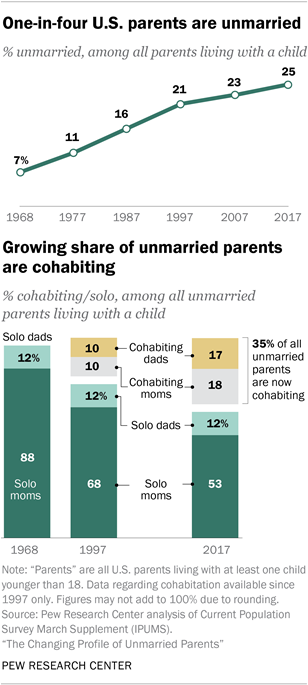 One-in-four parents living with a kid in the U.s. today are unmarried. Driven by declines in spousal relationship overall, besides as increases in births outside of union, this marks a dramatic modify from a half-century ago, when fewer than one-in-ten parents living with their children were unmarried (7%).
At the same time, the profile of unmarried parents has shifted markedly, according to a new Pew Inquiry Center analysis of Demography Agency data.1 Solo mothers – those who are raising at least one child with no spouse or partner in the home – no longer dominate the ranks of single parents as they once did. In 1968, 88% of unmarried parents fell into this category. Past 1997 that share had dropped to 68%, and in 2017 the share of unmarried parents who were solo mothers declined to 53%. These declines in solo mothers have been entirely offset past increases in cohabitating parents: Now 35% of all unmarried parents are living with a partner.ii Meanwhile, the share of unmarried parents who are solo fathers has held steady at 12%.
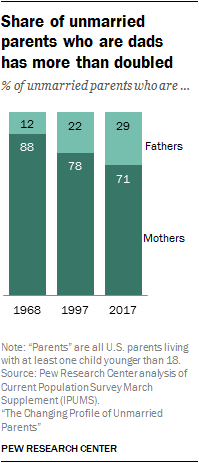
Due primarily to the ascent number of cohabiting parents, the share of single parents who are fathers has more than doubled over the past l years. Now, 29% of all single parents who reside with their children are fathers, compared with just 12% in 1968.
While it's well-established that married parents are typically better off financially than unmarried parents, there are also differences in fiscal well-being amid single parents. For example, a much larger share of solo parents are living in poverty compared with cohabiting parents (27% vs. 16%).3 There are differences in the demographic profiles of each group likewise. Cohabiting parents are younger, less educated and less likely to have e'er been married than solo parents. At the same time, solo parents have fewer children on average than cohabiting parents and are far more likely to be living with one of their own parents (23% vs. iv%).
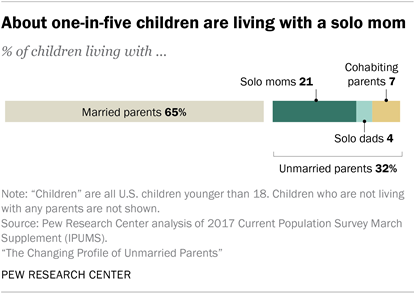 As the number of parents who are unmarried has grown, so has the number of children living with an unmarried parent. In 1968, 13% of children – nine one thousand thousand in all – were living in this type of arrangement, and by 2017, that share had increased to nearly one-third (32%) of U.S. children, or 24 one thousand thousand. However, the share of children who will always experience life with an unmarried parent is likely considerably higher, given how fluid U.South. families have go. One gauge suggests that past the time they turn 9, more than 20% of U.Due south. children built-in to a married couple and over fifty% of those born to a cohabiting couple will have experienced the breakup of their parents, for instance. The failing stability of families is linked both to increases in cohabiting relationships, which tend to exist less long-lasting than marriages, as well as long-term increases in divorce. Indeed, half of solo parents in 2017 (52%) had been married at ane fourth dimension, and the same is true for about ane-third of cohabiting parents (35%).
While it has become more than common in recent decades, many Americans view the increase in unmarried parenthood – solo mothering especially – every bit a negative trend for gild. In a 2015 Pew Research Center survey, two-thirds of adults said that more than unmarried women raising children on their own was bad for society, and 48% said the same nearly more unmarried couples raising children. Acceptance of unmarried parenthood tends to be particularly depression amongst whites, college graduates, and Republicans. Yet, other data suggest a slight uptick in acceptance. In 1994, 35% of adults agreed or strongly agreed that single parents could heighten children too equally two married parents, according to information from the Full general Social Survey; by 2012 the share who said equally much had risen to 48%.
Declines in union and increases in nonmarital births have driven rise in unmarried parenting
 The rise over the past half-century in the share of all U.South. parents who are unmarried and living with a child younger than 18 has been driven by increases in all types of unmarried parents. In 1968, only ane% of all parents were solo fathers; that figure has risen to 3%. At the aforementioned time, the share of all parents who are solo mothers has doubled, from vii% up to xiii%. Since 1997, the offset year for which data on cohabitation are available, the share of parents that are cohabiting has risen from four% to 9%.
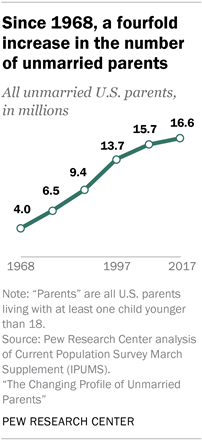
All told, more 16 million U.Southward. parents with no spouse at home are now living with their child younger than 18, up from 4 million in 1968 and merely under 14 million in 1997.
The growth in unmarried parenthood overall has been driven by several demographic trends. Maybe most important has been the refuse in the share of people overall who are married. In 1970, almost seven-in-ten U.S. adults ages 18 and older were married; in 2016, that share stood at fifty%. Both delays in marriage and long-term increases in divorce have fueled this trend. In 1968, the median historic period at showtime marriage for men was 23 and for women information technology was 21. In 2017, the median age at first marriage was 30 for men and 27 for women. At the same time, marriages are more than probable to end in divorce at present than they were nearly one-half a century ago.iv For instance, among men whose first marriage began in the tardily 1980s, most 76% were yet in those marriages x years later on, while this figure was 88% for men whose marriages began in the late 1950s.
 Not only are fewer Americans getting married, but information technology'south also becoming more mutual for unmarried people to have babies. In 1970 in that location were 26 births per 1,000 unmarried women ages fifteen to 44, while that rate in 2016 stood at 42 births per 1,000 unmarried women. Meanwhile, birthrates for married women take declined, from 121 births per 1,000 downwardly to most 90. As a consequence, in 2016 four-in-ten births were to women who were either solo mothers or living with a nonmarital partner.
Increases in the number of cohabiting parents raising children have too contributed to the overall growth in single parenthood. In 1997, the offset year for which data on cohabitation are bachelor, 20% of unmarried parents who lived with their children were also living with a partner.5 Since that time, the share has risen to 35%.
This trend has additional the overall share of single parents who are fathers. In 1968, just 12% were fathers; by 1997 the share had risen to 22%, and in 2017 it stood at 29%. At the same fourth dimension, solo parents remain overwhelmingly female: 81% of solo parents in 2017 were mothers, as were 88% in 1968.
For solo and cohabiting parents, very different demographic profiles
As a result of the rising and transformation of unmarried parenthood in the U.South., significant demographic differences now exist not simply between married and unmarried parents, but among unmarried parents. And in some cases, even among solo or cohabiting parents, dramatic differences have emerged between fathers and mothers.
Compared with cohabiting parents, solo parents are more likely to be female and black
Considering cohabiting parents are overwhelmingly opposite-sexual activity couples, they are about evenly split between men and women.6 Among solo parents, yet, the vast majority (81%) are mothers; simply 19% are fathers. This gender difference is even more pronounced amid black solo parents: 89% are mothers and just 11% are fathers.
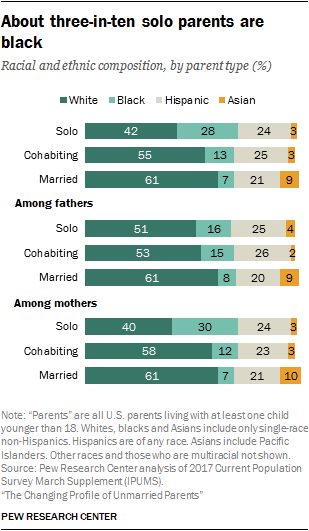 Overall, there are significant differences in the racial and ethnic profiles of solo and cohabiting parents. Among solo parents, 42% are white and 28% are black, compared with 55% of cohabiting parents who are white and 13% who are black.
These gaps are driven largely by racial differences amidst the large share of solo parents who are mothers. Solo moms are more than than twice as likely to exist black as cohabiting moms (30% vs. 12%), and roughly four times as likely as married moms (7% of whom are black). Four-in-10 solo mothers are white, compared with 58% of cohabiting moms and 61% of married moms.
There are almost no racial and ethnic differences in the profiles of solo and cohabiting fathers. About one-half of each group are white, roughly fifteen% are black, well-nigh i-fourth are Hispanic and a modest share are Asian. Married fathers, nevertheless, are more likely than unmarried fathers to be white (61% are) and less likely to be black (8%).
Only 3% of solo or cohabiting parents are Asian, compared with 9% of married parents. A like pattern emerges among both Asian fathers and mothers.
Amidst all parents, Hispanics are about equally represented across all 3 family unit types – solo, cohabiting and married parents – with no large differences amongst Hispanic mothers and Hispanic fathers.
Solo parents are older, more educated and more likely to accept been married than cohabiting parents
 Cohabiting parents are younger on average than solo or married parents. Their median age is 34 years, compared with 38 amidst solo parents and 40 among married parents.
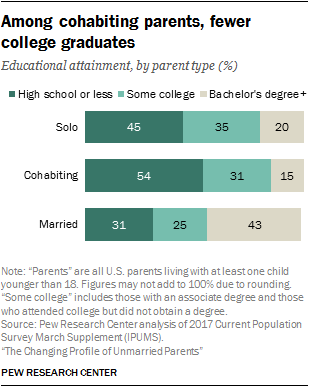
Cohabiting parents take lower levels of educational attainment than other parents, due at least in part to their relative youth. But over one-half (54%) of cohabiting parents have a loftier school diploma or less education, compared with 45% of solo parents and 31% of married parents. At the other finish of the spectrum, 15% of cohabiting parents have at least a bachelor's caste, compared with twenty% of solo parents. Married parents, in dissimilarity, are more than twice as likely equally unmarried parents to have a bachelor's degree (43% do), reflecting the growing gap in marriage across educational levels.
 Cohabiting fathers, in particular, take lower levels of pedagogy than their solo counterparts. Roughly six-in-ten cohabiting fathers (61%) – versus 51% of solo fathers – take a loftier school diploma or less education. Conversely, just 12% of cohabiting fathers take a bachelor's degree, while 21% of solo fathers exercise. There are no large educational differences in the contour of solo and cohabiting mothers.
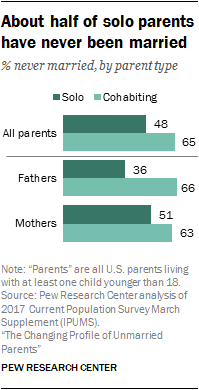
The relative youthfulness of cohabiting parents also contributes to the loftier share (65%) that take never married, meaning that most children with cohabiting parents were built-in outside of union. In dissimilarity, about one-half (48%) of solo parents have never been married.
Cohabiting mothers and fathers are about as likely to accept never married. Among solo parents, however, mothers are more likely than fathers to have never been married (51% of solo mothers vs. 36% of solo fathers), suggesting that solo mothers and solo fathers may take somewhat unlike paths to single parenthood.
Iii-in-ten solo mothers are living in poverty
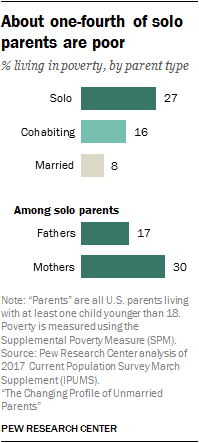 Despite the fact that cohabiting parents are younger and less educated than solo parents, they are still far less probable to be poor. All told, xvi% of unmarried parents living with a partner are living below the poverty line, while almost one-fourth (27%) of solo parents are. In comparing, merely 8% of married parents are living in poverty.vii
Among solo parents, mothers are virtually twice as probable as fathers to exist living below the poverty line (30% vs. 17%), but poverty rates for cohabiting parents don't differ amongst mothers and fathers.
Solo and cohabiting parents are nigh equally likely to exist employed (72% and 73%, respectively). However, a majority (53%) of cohabiting parents are in a dual-earner household, which accounts for some of the differences in poverty levels between the 2 groups.
Roughly one-in-4 solo parents are living with their own parent
Not but practice solo and cohabiting parents differ in terms of their demographic and economic profiles, but their household situations are dissimilar likewise. Solo parents don't have a partner at domicile, but they are far more likely than their married and cohabiting counterparts to be living with at least i of their ain parents – 23% practice. This is especially common amidst solo dads, 31% of whom are residing with at least one of their parents. Among solo moms, this figure stands at 22%. In comparison, only 4% of cohabiting parents are living with at least one of their ain or their partner's parents – the same share equally amongst their married counterparts.
 While the role of these grandparents cannot be determined for certain from this data, prior Pew Research Middle analyses of 2011 Census Bureau information suggest that many could be playing an important role as caregiver to any grandchildren in the household. In fact, a 2013 analysis plant that among all grandparents who lived with at least i grandchild at the fourth dimension (whether the child'south parent was present or not), about four-in-10 (39%) said they were responsible for most of that grandchild's bones needs.
Cohabiting parents have more children, on boilerplate, than solo parents do. Simply over half (53%) of cohabiting parents have more than ane child at abode, compared with 44% of solo parents. Among solo parents, though, moms are more likely than dads to have multiple kids at home – almost half (46%) practise, while 35% of solo fathers are raising more one kid.
Cohabiting parents are also more likely than their solo counterparts to have young children at home. This is linked to the fact that they themselves tend to be younger. Fully 60% of cohabiting parents are living with at least ane child younger than half dozen, compared with 37% of solo parents and 44% of married parents. Among solo parents, mothers are much more likely than fathers to have a preschool-age child in the business firm. About four-in-ten (39%) do, compared with 26% of dads.
Public views of single parenthood
As unmarried parenthood has grown more than common in the U.S., the public has become somewhat more accepting of information technology, though large shares say that this trend is bad for society.
A 2015 Pew Research Center survey found that the trends toward more single women having children and more than unmarried couples raising children were seen equally relatively more harmful to society, compared with other changes in American families.viii
Americans were far more likely to express a negative view regarding the rise of single mothers than any other tendency: Two-thirds (66%) said that more unmarried women having children was bad for society, and just 4% said this trend was good for order (the remaining 29% said the trend doesn't make much difference). At the same fourth dimension, most one-half (48%) said more unmarried couples raising children was bad for society, while just half-dozen% said it was good for lodge and 45% said information technology didn't brand much departure.
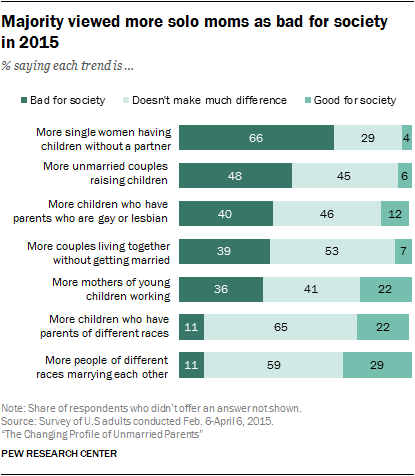 By comparison, other family trends were seen as less negative, though substantial shares saw some of those trends as bad for guild. For instance, iv-in-ten adults said that the growing number of children who have parents who are gay or lesbian was bad for guild, and a like share (39%) said the same virtually more couples living together without being married. When information technology came to more mothers of young children working outside the home, 36% said this was a bad thing, merely a sizable minority (22%) saw it as a proficient affair. Relatively few Americans (eleven%) said the trends toward more children with parents of dissimilar races and more interracial marriages were bad for society; at least twice as many viewed each of these trends as good for guild (22% and 29%, respectively). In each instance, majorities or pluralities of the public said these trends didn't brand much of a difference for society.
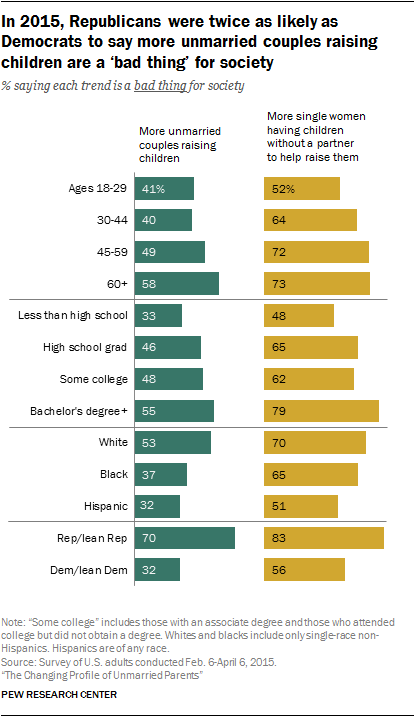 Views on unmarried parents vary widely by party affiliation. The overwhelming majority (83%) of Republicans and independents who lean to the Republican Party said that more unmarried women having children without a partner is bad for society; 56% of Democrats and those who lean Democratic said the same. Partisan differences were even wider on attitudes nearly unmarried parents raising children together: While lxx% of Republicans saw this as bad for society, about one-half as many Democrats (32%) said the same.
Older Americans and those with college levels of education were particularly likely to view these trends as bad for club.
There were racial and ethnic gaps as well, particularly on views about unmarried couples raising children: 53% of whites viewed more than unmarried couples raising children as a bad thing, compared with 37% of blacks and 32% of Hispanics.
Other information propose there has been some softening in views towards unmarried parenthood. In 2012, 48% of adults agreed or strongly agreed that unmarried parents could heighten children as well equally ii parents tin can, co-ordinate to the General Social Survey. This marked a slight increase from 1994, when just 35% said as much. At the aforementioned time, the share of people who disagreed or strongly disagreed that single parents could raise children as well as two parents ticked down, from 48% to 41%.
About the data
This study is based primarily on data from the U.S. Census Bureau'southward March Supplement of the Current Population Survey (CPS), also known as the Annual Social and Economic Supplement (ASEC). The survey produces a nationally representative sample of the not-institutionalized U.S. population. The analysis in this report starts with 1968, the first year for which ASEC data are publicly available.
Because the CPS is based on households, only parents who are living with at least one of their children younger than xviii are included in this analysis. Prior Pew Research Center analysis indicates that 17% of fathers of children younger than 18 are living apart from all of these children, and fathers living apart from their children take dissimilar characteristics than those who alive with their children.
The CPS does non explicitly ask near custody arrangements, but any parent whose kid lives with them most of the time is counted every bit "living with" that kid. In cases where custody is split 50-50, the parent is counted as "living with" their kid if the child is present at the time of the interview.
Throughout this report, "fathers," "mothers" and "parents" refer to people who are living with their kid younger than eighteen years, and to people who are their spouses or partners. These include both biological parents and parents who are non biologically linked to the children in their family unit.
The Electric current Population Survey (CPS) does not explicitly ask about custody arrangements, but any parent whose kid lives with them most of the time is counted equally "living with" that child. In cases where custody is separate 50-50, the parent is counted every bit "living with" their child if the kid is present at the time of the interview.
All cohabiting parents – meaning parents who are living with a partner to whom they are non married – are identified in analyses since 2007. From 1995 to 2006, the CPS only collected data on cohabitation among unmarried household heads, so only those respondents and their partners are counted as cohabiting. This leads to an undercount of cohabiting parents for those years. The size of this undercount prior to 2007 can't be determined, but in 2007 the vast majority (93%) of all cohabiting parents were either the head of household or the partner of the head. Prior to 1995, cohabiting couples were not identified in the CPS.
All same-sex couples, regardless of their marital status, are classified as "cohabiting," since that is the convention used in the CPS. For more than on same-sex activity parents, see "LGB Families and Relationships: Analyses of the 2013 National Health Interview Survey."
The small share of parents who are married but not living with a spouse or partner are classified equally "solo parents," along with those who are neither married nor living with a partner.
"Some higher" includes those with an associate degree and those who attended college but did not obtain a degree. "Loftier school" includes those who have a high school diploma or its equivalent, such as a General Didactics Evolution (GED) document.
Whites, blacks and Asians include only single-race not-Hispanics. Hispanics are of any race. Asians include Pacific Islanders.
stodartnesintlefor.blogspot.com
Source: https://www.pewresearch.org/social-trends/2018/04/25/the-changing-profile-of-unmarried-parents/
0 Response to "what percentage of babies are born to single mothers"
Post a Comment